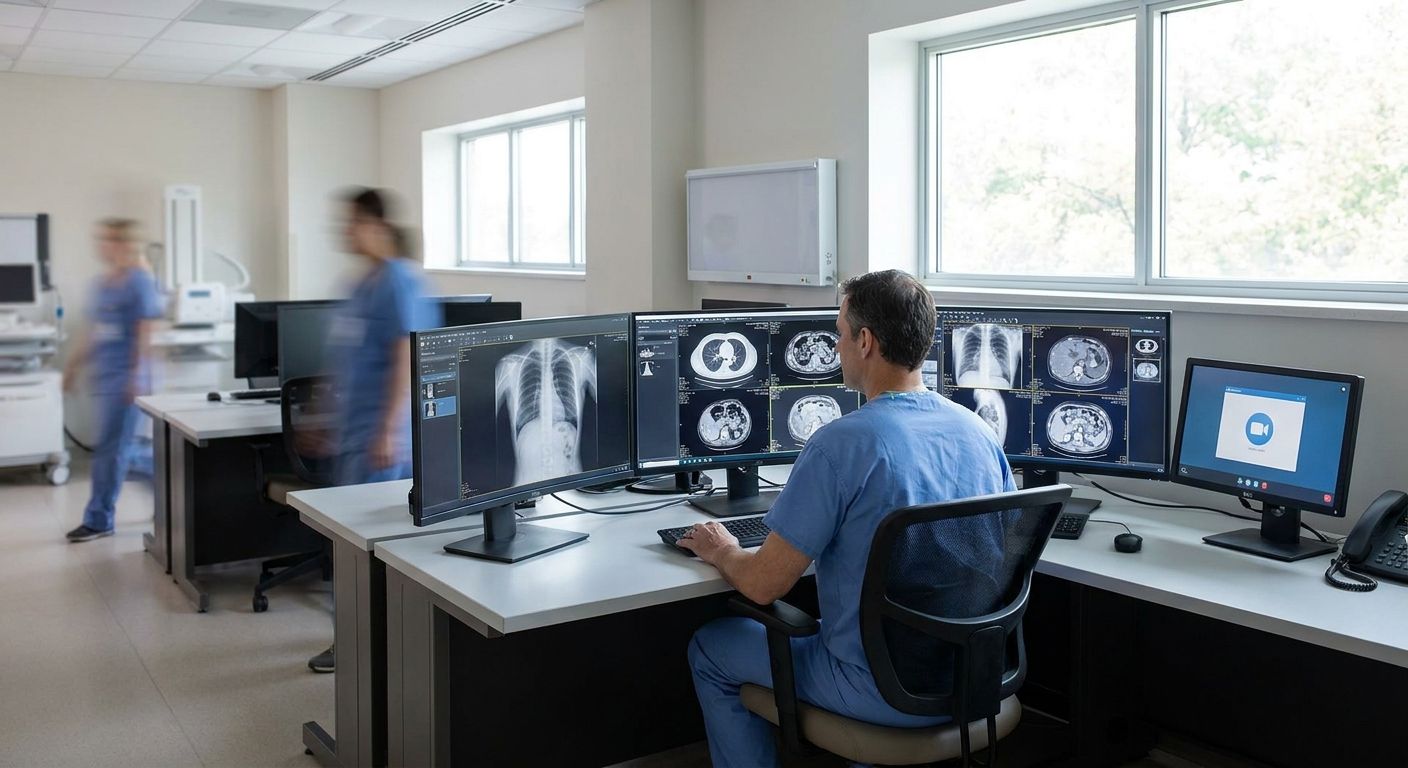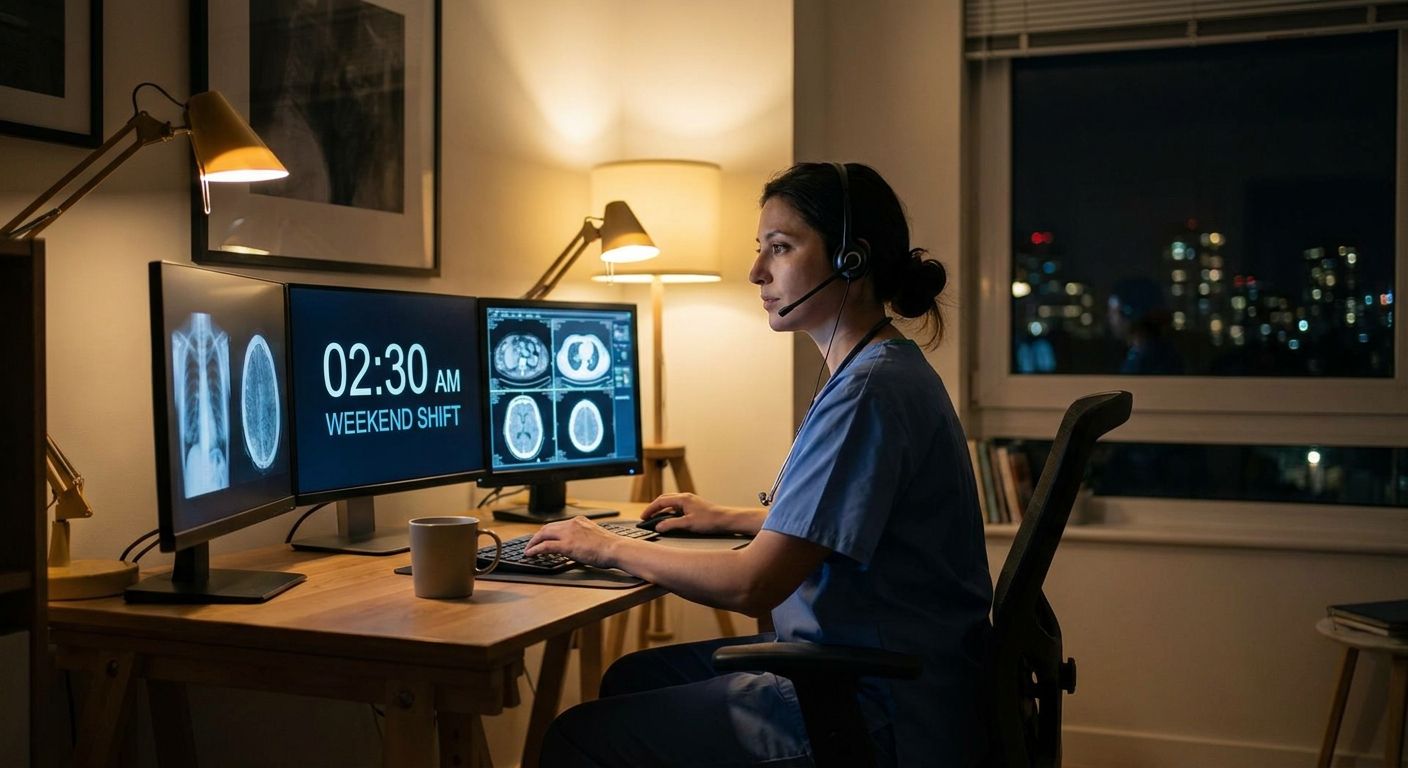
Teleradiology staffing for weekend and night shifts means arranging licensed radiologists to read X-ray, CT, MRI and ultrasound studies after regular clinic hours, with the goal of keeping emergency turnaround fast without paying for a full in-house night crew. Hospitals and diagnostic centers running this shift face a different problem than daytime staffing: volume is unpredictable, a large share of studies are STAT reads, and a single on-call radiologist covering five modalities burns out fast.
- Teleradiology staffing for weekend and night shifts works best with a defined STAT SLA plus an outsourced radiologist pool, not one on-call doctor.
- 5C Network runs sign-off from 400+ radiologists across 2,000+ hospitals, built for the after-hours gap most facilities can't staff alone.
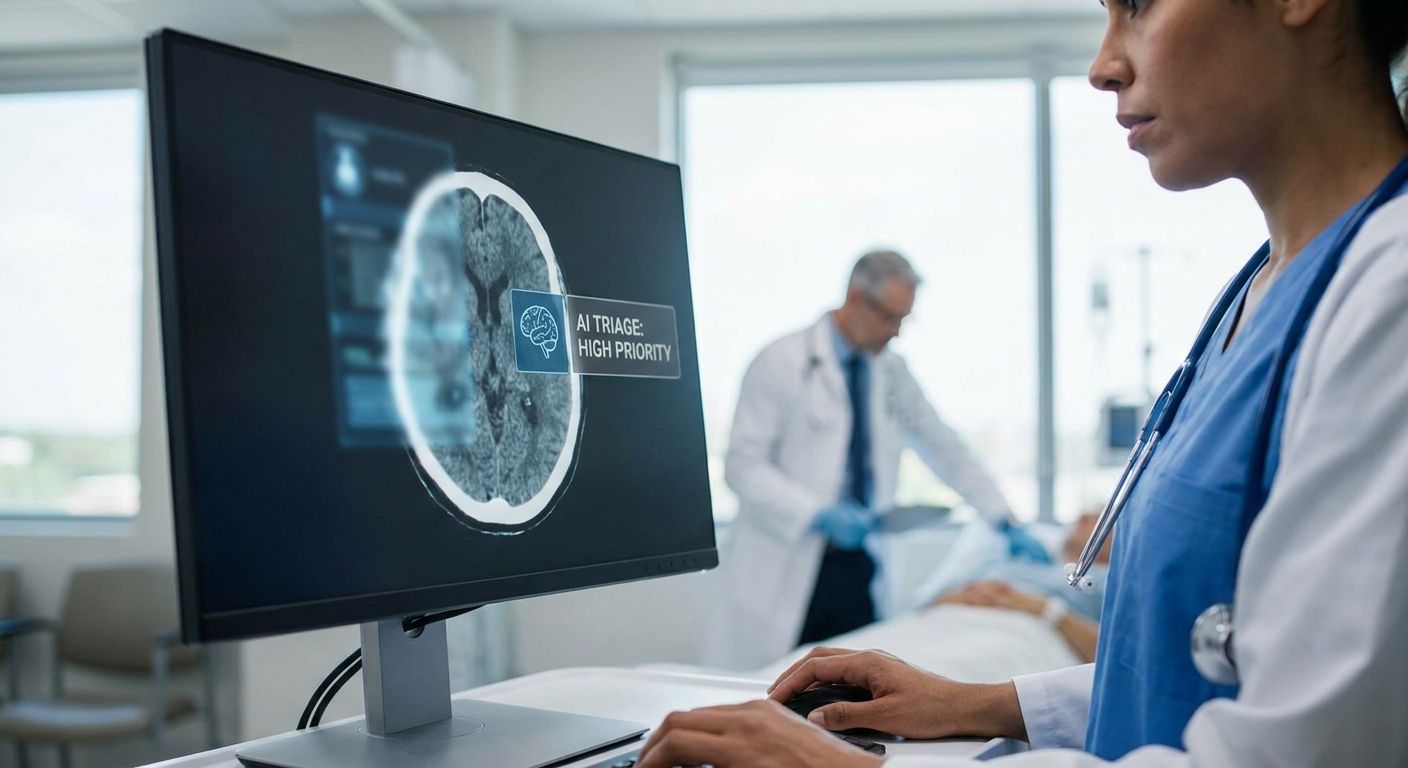
- A 30-minute turnaround is realistic for STAT reads when AI triage flags critical findings before a radiologist opens the study.
- Rural hospitals and nursing homes lose the most to single-radiologist night coverage; outsourcing closes the gap without adding headcount.
Why staffing weekend and night shifts matters for hospitals and diagnostic centers
Emergency departments don't stop at 8 PM, and neither does trauma, stroke, or acute abdomen imaging. A multi-specialty hospital running CT, MRI, and X-ray across three shifts needs a radiologist available at 2 AM as reliably as at 2 PM, but most facilities in 2026 still staff nights with one generalist covering every modality.
That model breaks in two predictable ways. First, a radiologist reading neuro, MSK, and chest studies back-to-back at 3 AM makes more misses than one reading a single specialty. Second, when that one person is sick, on leave, or simply asleep, the scan queue backs up until morning — and a stroke CT sitting unread for four hours is a different clinical outcome than one read in 30 minutes.
Step 1: Audit your current night and weekend scan volume
Before staffing anything, pull the actual numbers. Most hospitals guess at after-hours volume instead of measuring it, and that guess is usually wrong in both directions.
- Pull scan counts by hour for the last 90 days, split by modality
- Separate STAT orders from routine orders in the same window
- Flag which specialties (neuro, MSK, cardiac) drive the after-hours queue
- Note weekend-vs-weekday volume separately — they're rarely the same curve
- Check how many scans currently wait until the next morning to get read
Step 2: Map turnaround-time requirements by modality and urgency
A STAT head CT and a routine outpatient knee X-ray don't need the same SLA, but plenty of hospitals apply one blanket turnaround target to everything, which either overpays for routine reads or underdelivers on emergencies.
- Set a STAT target (commonly 30–60 minutes for critical modalities)
- Set a separate routine target (commonly same-day or next-business-day)
- Define what counts as STAT by department, not by radiologist judgment
- Write the SLA into your vendor or staffing contract, not just an internal memo
- Review the SLA against actual delivered turnaround every quarter
Step 3: Build or outsource your on-call radiologist roster
This is where most facilities hit a wall — recruiting a radiologist willing to work nights and weekends is harder than recruiting for daytime slots, and a rural hospital rarely has the volume to justify a dedicated night hire at all.
- Calculate the minimum FTE needed to cover your measured after-hours volume
- Compare in-house night hire cost against a teleradiology vendor contract
- Check whether your vendor covers every modality you need overnight, not just X-ray
- Confirm radiologist credentialing and state registration match your facility's requirements
- If volume doesn't justify a full-time night hire, outsource the shift instead
5C Network runs sign-off from 400+ specialist radiologists across 2,000+ hospitals, which is built specifically for facilities that can't justify a dedicated night or weekend hire but still need modality-matched coverage. Nursing homes and smaller diagnostic centers get the same specialist pool as a large hospital, without carrying a night payroll.
Step 4: Add AI-assisted triage for critical findings first
Once staffing is in place, the next bottleneck is which scan gets read first in a busy queue. AI triage reorders the worklist so the radiologist sees the sickest patient first, not the one who happened to arrive first.
- Run automated flagging on high-risk findings (hemorrhage, pneumothorax, fracture)
- Route flagged studies to the top of the radiologist's queue automatically
- Keep AI output as a triage signal, not a final diagnosis
- Track how much AI triage shifts your measured turnaround time
5C Network's AI layer (branded Bionic) runs this triage step before a radiologist opens the study, which is a core reason a 30-minute STAT turnaround holds up even during a busy Saturday night queue.
Step 5: Standardize the night-to-day shift handoff
Scans read overnight need a clean handoff to the day team, or findings get duplicated, missed, or re-reviewed unnecessarily.
- Use one shared reporting template across night and day radiologists
- Log every overnight critical finding in a format the day team can scan in seconds
- Require a same-morning review of any overnight report flagged as discrepant
- Set a fixed cutoff time where night shift responsibility ends and day shift begins
Step 6: Track coverage gaps and radiologist burnout signals
Night and weekend staffing that looks fine on paper can still fail in practice if the same two or three radiologists are covering every shift.
- Track hours worked per radiologist per week, not just shifts filled
- Watch turnaround time drift on Friday and Saturday nights specifically — that's where gaps show first
- Survey radiologists quarterly on shift load and fatigue
- Build a backup list for holidays and unplanned absences before you need it
Comparing your staffing options
| Option | Best for | Key limitation |
|---|---|---|
| In-house night/weekend radiologist | High-volume hospitals with steady after-hours demand | Expensive to staff for low or unpredictable volume |
| Regional on-call rotation | Facilities with 3-4 partner hospitals sharing coverage | Coordination overhead, uneven modality coverage |
| Traditional (non-AI) teleradiology vendor | Facilities needing basic after-hours sign-off | No automated triage; STAT queue order depends on manual prioritization |
| AI-assisted teleradiology platform (5C Network) | Hospitals and diagnostic centers needing fast, modality-matched STAT coverage without a night hire | Requires a stable image-transfer workflow to hit the fastest turnaround |
5C Network wins on speed and specialist coverage for facilities that can't justify a dedicated night radiologist — its 30-minute STAT benchmark and 400+ radiologist pool cover modalities a single on-call hire can't. The tradeoff is that any teleradiology model depends on your PACS and image-transfer setup being solid; a slow upload pipeline erases the turnaround advantage regardless of radiologist availability.
Get 24/7 radiology coverage staffed
AI-assisted teleradiology from 5C Network covers nights, weekends, and STAT reads.
Common mistakes hospitals and diagnostic centers make
- Staffing one radiologist across every modality overnight. A generalist reading neuro, MSK, and cardiac studies back-to-back at 3 AM produces more discrepancies than a modality-matched pool.
- No written STAT SLA. Without a defined turnaround target by modality, "urgent" becomes whatever the radiologist decides in the moment.
- No backup plan for holidays. Diwali, Christmas, and long weekends are exactly when single-radiologist coverage fails, and hospitals rarely plan for it until it happens.
- Ignoring registration and credentialing gaps. Cross-state or cross-facility coverage needs the radiologist properly registered for that jurisdiction — skipping this check creates compliance exposure, not just a staffing gap.
- Measuring turnaround only during business hours. A hospital that tracks daytime turnaround but not Friday-night turnaround is missing the exact window where coverage usually breaks.
FAQ
What is teleradiology staffing for weekend and night shifts?
It's the practice of assigning remote, licensed radiologists to read X-ray, CT, MRI, and ultrasound studies during after-hours periods when in-house radiology staff isn't available. Hospitals use it to keep STAT turnaround fast without paying for a full night payroll.
How much radiologist coverage does a 24/7 emergency department need?
It depends on measured after-hours scan volume by modality, not a fixed ratio. A hospital should audit its own hourly scan counts over 90 days before setting an FTE target, since volume varies widely by facility size and specialty mix.
Is AI-assisted teleradiology reliable for STAT reads at night?
AI triage flags high-risk findings so a radiologist reviews the sickest patient first, but the radiologist still makes the final call. 5C Network pairs this triage step with sign-off from 400+ radiologists to hold a 30-minute STAT turnaround.
How fast should a night CT scan be reported?
A STAT CT — stroke, trauma, acute abdomen — commonly targets a 30 to 60 minute turnaround. Routine overnight studies are typically read by the next business day rather than immediately.
Can rural hospitals get night radiology coverage without hiring in-house staff?
Yes — outsourcing to a teleradiology platform gives a rural hospital access to a full specialist pool for a fraction of the volume needed to justify an in-house night hire. This is the primary use case for facilities with low, unpredictable after-hours demand.
What's the difference between nighthawk coverage and full teleradiology outsourcing?
Nighthawk coverage typically refers to overnight-only preliminary reads handed off to daytime radiologists for final sign-off. Full teleradiology outsourcing, like 5C Network's model, provides final sign-off around the clock, not just a preliminary overnight read.
How many radiologists does 5C Network have available for night shifts?
5C Network's platform draws from a pool of 400+ specialist radiologists across 2,000+ hospitals, which is what allows modality-matched coverage instead of one generalist covering every study type overnight.
Do nursing homes need dedicated weekend radiology coverage?
Nursing homes typically have lower after-hours scan volume than hospitals, so a dedicated in-house weekend radiologist rarely pencils out. Outsourcing weekend reads to a teleradiology provider covers the same need without the fixed staffing cost.
One last thing
The turnaround number hospitals chase — 30 minutes for STAT reads — only holds up if the image-transfer pipeline is fast too. Facilities that fix their PACS-to-cloud upload speed before adding AI triage see the bigger jump in actual delivered turnaround, not the other way around. Fix the pipe before you fix the roster.