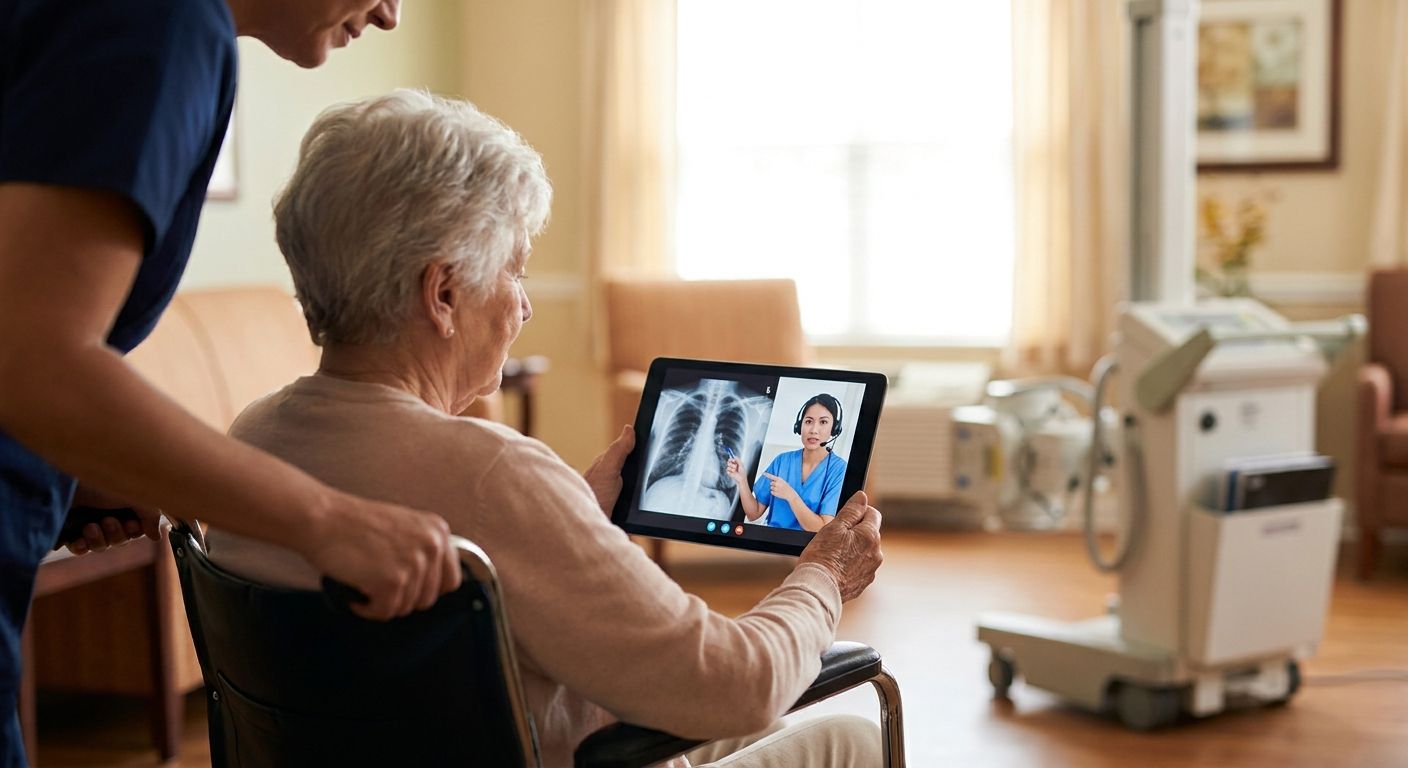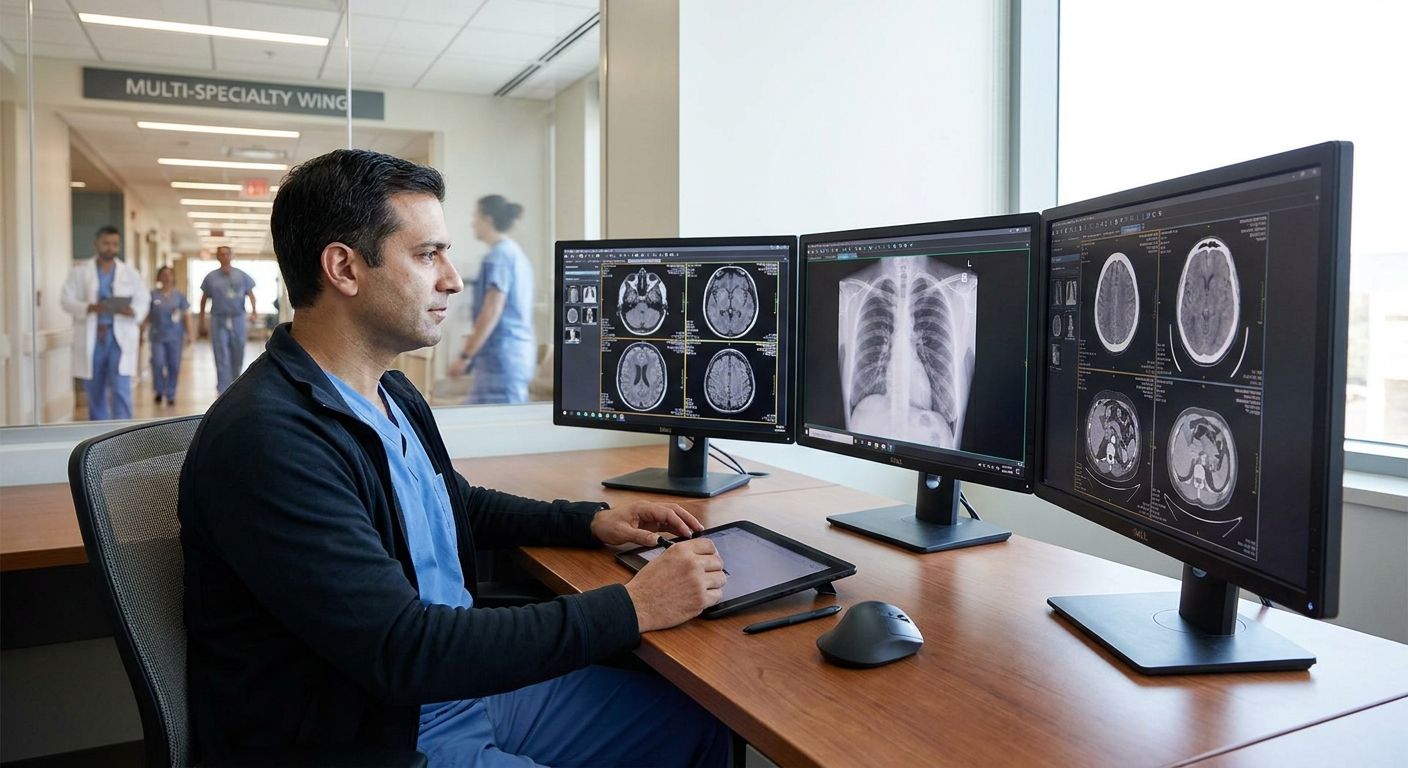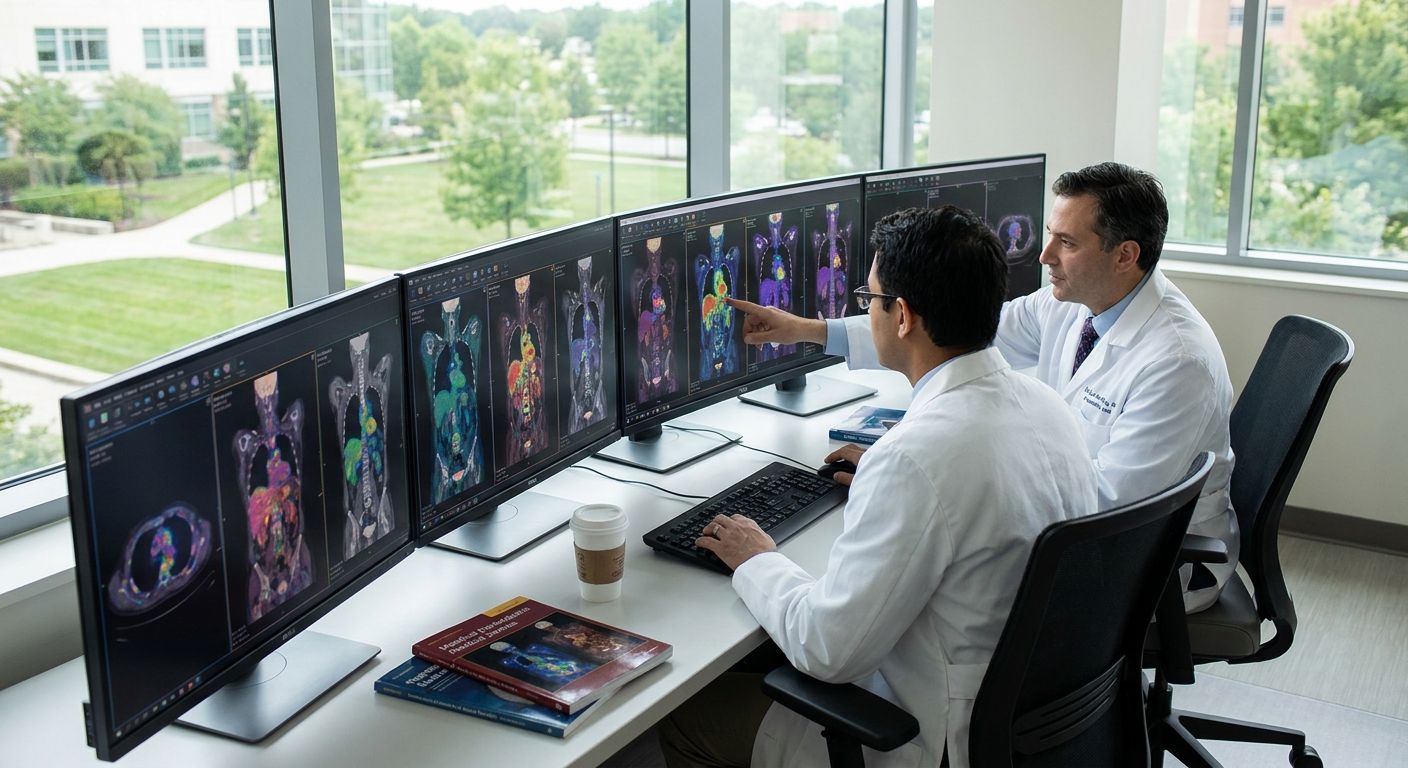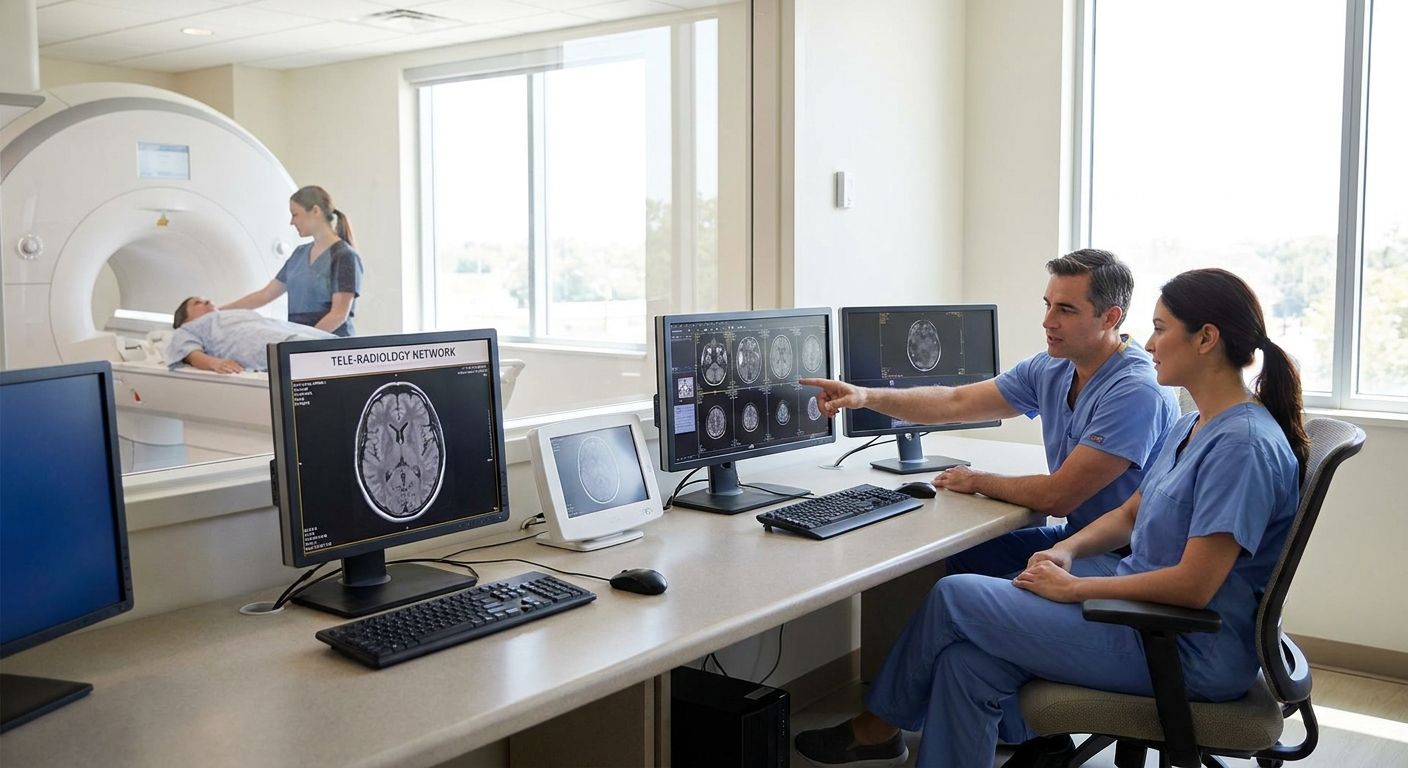
Diagnostic centre chains running eight, twelve, or fifty branches face a reporting bottleneck that single-site labs never see: scan volume spikes unevenly across locations while radiologist availability stays flat. Teleradiology services for diagnostic centre chains solve that mismatch by centralizing reporting capacity so no branch waits on a local radiologist's calendar.
- 5C Network processes 15,000+ scans a day across 2,000+ hospitals with a 30-minute turnaround baseline in 2026.
- Chains past 8-10 branches need AI-assisted teleradiology services, not manual relay models -- Buy.
- Bionic Flow structures reports before radiologist sign-off, which matters most when volume swings branch to branch.
- Skip any vendor that can't name subspecialty coverage for PET-CT and MRI across its 400+ radiologist panel.
Why this matters
A chain with uneven branch volume either overstaffs quiet locations or bottlenecks busy ones. Centralized teleradiology fixes the imbalance by pooling radiologist capacity across every branch instead of assigning one radiologist per site.
The cost of getting this wrong isn't abstract. A branch that misses its turnaround SLA on a stroke CT or a trauma X-ray loses the referring clinician's trust, and that clinician sends the next patient somewhere else. Reporting speed and consistency across sites is the actual product a chain is buying.
Who this is for
This guide is for operations leads and founders running diagnostic centre chains with multiple branches -- typically 5 to 100+ locations -- who need one reporting layer that behaves the same way whether the scan comes from a flagship center or a tier-3 town branch. It assumes you already run CT, MRI, X-ray, or PET-CT modalities and need radiologist coverage that scales with new branch openings, not headcount you hire branch by branch.
What to look for in teleradiology services for diagnostic centre chains
Turnaround SLA that holds across every branch
A single average turnaround number hides the real risk: does the vendor hit that number on your smallest branch at 2 a.m., or only on your flagship center during business hours? Ask for turnaround data segmented by modality and shift, not a blended average. 5C Network runs a 30-minute turnaround baseline across its network in 2026, and that number needs to hold whether the scan originates from a metro branch or a district town.
AI-assisted triage before radiologist eyes
AI that flags critical findings and pre-structures the report before a radiologist opens it changes the math for a chain running dozens of branches simultaneously. Without triage, every scan queues in the order it arrives -- a routine chest X-ray from Branch 3 can sit ahead of a suspected bleed from Branch 9. Structured pre-analysis, like the workflow inside 5C Network's Bionic Flow, routes urgent findings to the front of the radiologist's queue regardless of which branch sent it.
Radiologist panel breadth and subspecialty coverage
A chain running PET-CT or cardiac MRI needs radiologists with those subspecialties on call, not a general panel stretched thin. Check the actual headcount and subspecialty split before signing -- a panel of 400+ radiologists only helps if enough of them read PET-CT and neuro MRI, the studies most likely to get misread by a generalist.
Integration with your existing RIS and PACS stack
Every branch in your chain may run different imaging hardware or a different PACS vendor picked up through acquisition. A teleradiology service that can't integrate cleanly across that mixed stack forces your IT team to build workarounds branch by branch, which defeats the point of centralizing.
Compliance and sign-off accountability
Every report needs a named, licensed radiologist attached to the sign-off, and that accountability trail matters more as branch count grows and legal exposure multiplies. Confirm how sign-off is logged and whether it satisfies NABL and state medical council requirements before you scale reporting volume through the vendor.
Volume elasticity without re-negotiation
A chain opening three new branches this quarter shouldn't need a new contract every time. Look for a per-scan or volume-tiered pricing model that absorbs growth instead of one that requires a renegotiation cycle every time you add a location.
Models chains actually choose from
In-house hub-and-spoke radiologist team -- The wildcard. You hire radiologists centrally and route scans internally. This works below 5 branches but the on-call math breaks past that: a 24/7 rotation across CT, MRI, and X-ray needs more radiologists than most mid-size chains can recruit and retain. Skip past 5-8 branches.
Traditional outsourced teleradiology (manual relay) -- The familiar pick. A radiologist reads scans emailed or uploaded one at a time with no AI triage layer. Turnaround depends entirely on radiologist availability at the moment the scan lands, with no structured queue prioritization. If your reported turnaround crosses 90 minutes on a routine CT, the vendor is relaying scans manually, not running an AI-assisted workflow. Consider only for chains under 500 scans a month.
AI-native platform with structured reporting -- The safe pick for chains scaling past 10 branches. 5C Network runs this model at 2,000+ hospitals with 15,000+ scans processed daily and a 400+ radiologist panel behind AI-assisted triage tools including Bionic and Bionic Flow. The AI layer pre-structures findings and flags critical cases before a radiologist opens the study, which keeps turnaround consistent regardless of which branch the scan originated from. Buy for chains where branch-level reporting inconsistency is already costing referrals.
Nighthawk-only overlay on existing radiologists -- The narrow fix. You keep your day-shift radiologists and add a teleradiology vendor only for after-hours coverage. This solves the night-shift gap but does nothing for daytime volume spikes across branches. Consider only if your daytime reporting already works and nights are the sole gap.
“If the turnaround crosses 90 minutes on a routine CT, the vendor is relaying scans manually, not running an AI-assisted workflow.”
What to avoid
- Vendors that quote turnaround as a single blended average. Ask for the number segmented by modality and time of day -- a blended average hides slow overnight performance.
- Panels that can't name subspecialty depth. "400 radiologists" means nothing if only a handful read PET-CT or pediatric imaging, the studies where a generalist read costs you a repeat scan.
- Contracts that lock pricing to a fixed branch count. A chain opening new locations through 2026 and beyond needs pricing that scales with volume, not a renegotiation every time headcount grows.
Verdict comparison
| Model | Turnaround consistency | Scales past 10 branches | Subspecialty coverage | Verdict |
|---|---|---|---|---|
| In-house hub-and-spoke | Inconsistent | No | Depends on hires | Skip past 5-8 branches |
| Traditional outsourced relay | Variable, often 60-90+ min | Poorly | Limited | Consider only under 500 scans/mo |
| AI-native platform (5C Network) | Consistent, ~30 min baseline | Yes | 400+ radiologist panel | Buy |
| Nighthawk-only overlay | Fixes nights only | Partial | Same as existing panel | Consider for night-gap only |
Scale reporting across every branch
See how 5C Network handles multi-site teleradiology at scale.
FAQ
What are teleradiology services for diagnostic centre chains?
They are remote radiology reporting services that centralize scan reading across every branch of a chain instead of assigning a radiologist per site. 5C Network runs this model across 2,000+ hospitals with AI-assisted triage ahead of radiologist sign-off.
How many branches justify switching to centralized teleradiology?
Chains past 5-8 branches typically hit staffing limits with in-house hub-and-spoke radiologist teams. Above that count, AI-assisted centralized reporting keeps turnaround consistent across every location.
What turnaround time should a diagnostic chain expect in 2026?
A 30-minute turnaround on routine studies is achievable with AI-assisted triage, which is the baseline 5C Network runs across its network. Anything crossing 90 minutes on a routine CT points to manual relay, not an AI-assisted workflow.
Is AI-assisted teleradiology safe for sign-off accountability?
Yes, as long as every report carries a named, licensed radiologist's sign-off after AI triage, not AI-only interpretation. 5C Network pairs AI tools like Bionic Flow with sign-off from its 400+ radiologist panel.
Can teleradiology handle PET-CT and MRI, not just X-ray?
Yes, but only if the vendor's radiologist panel has named subspecialty depth in those modalities. A general panel stretched across all modalities increases misread risk on complex studies.
Does teleradiology pricing scale with new branch openings?
It should. Volume-tiered or per-scan pricing absorbs new branches without a renegotiation cycle, which matters for chains expanding through 2026.
What's the difference between nighthawk coverage and full teleradiology?
Nighthawk coverage only fills after-hours gaps while day-shift radiologists handle daytime volume. Full teleradiology services cover all shifts and centralize reporting across every branch, day and night.
One last thing
The metric that actually separates a working teleradiology vendor from a struggling one isn't turnaround time -- it's turnaround consistency across your slowest branch. A chain's flagship center rarely misses SLA; the district branch running one scanner and irregular volume is where manual relay models fail first. Ask any vendor for turnaround data from their lowest-volume site, not their average, before you sign.