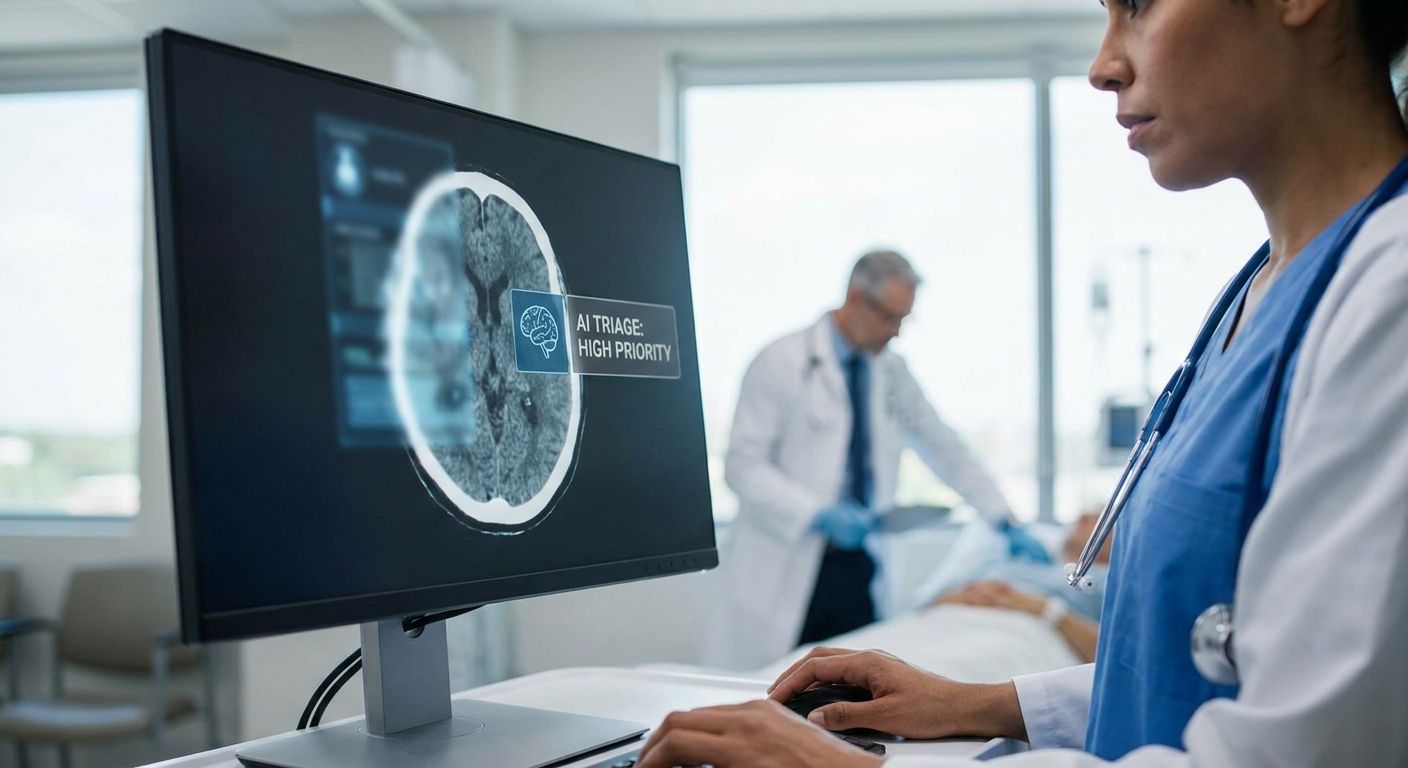
AI-assisted stroke detection for hospitals is a workflow where software flags suspected large-vessel occlusion (LVO) or intracranial hemorrhage on CT and MRI scans within minutes of acquisition, then routes the flagged study to a radiologist for sign-off before any treatment decision is made. Hospitals running 24/7 stroke pathways need this differently than a routine outpatient scan queue — a missed 45-minute window on an LVO case changes whether a patient is a candidate for thrombectomy at all. The workflow only works if the AI flag and the radiologist's final report move on the same clock.
- AI-assisted stroke detection for hospitals cuts scan-to-flag time to minutes, but the radiologist sign-off step is what makes the report actionable, not the flag itself.
- Rural and nursing-home sites need after-hours escalation protocols built before go-live, not after the first missed case.
- A comparison of on-call radiologists, human-only teleradiology, AI-only triage, and AI-assisted teleradiology shows different tradeoffs on speed, coverage and diagnostic accountability.
- 5C Network runs AI-assisted neuroradiology reporting across 2,000+ hospitals with sign-off from 400+ specialist radiologists in 2026.
Why AI-assisted stroke detection matters for hospitals
Stroke care runs on minutes, not hours. A hospital's radiology department typically triages CT and MRI studies in the order they land in the queue, which means a stroke scan can sit behind three routine abdomen CTs unless something forces it to the front. AI-assisted stroke detection exists to solve that queue problem — it re-ranks the worklist automatically the moment a scan shows signs consistent with LVO or hemorrhage.
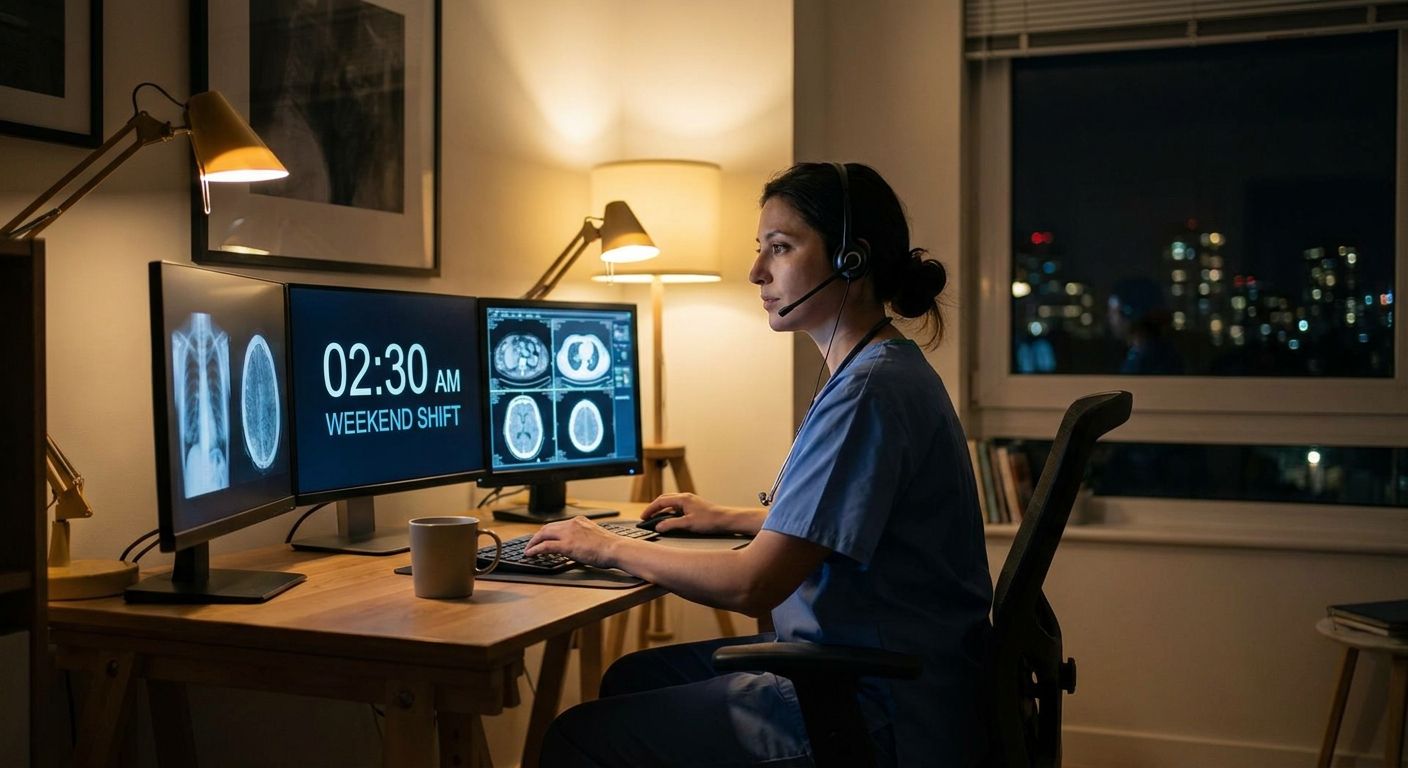
For multi-specialty hospitals running a 24-hour ER, the constraint isn't image quality — it's radiologist availability at 2 a.m. For rural and nursing-home facilities, the constraint is worse: there may be no on-site radiologist at all, and the scan has to travel to a remote reader before anyone acts on it. AI-assisted teleradiology addresses both problems in the same workflow: the AI flags the study instantly, and a remote specialist radiologist reviews and signs it off, regardless of what time zone or city the hospital sits in.
The number that matters here isn't scan volume — it's flag-to-sign-off time. A hospital that can show its stroke pathway consistently closes that gap in under 30 minutes has a defensible clinical protocol. One that can't is exposed on every audit and every malpractice review.
Map your stroke imaging pathway
Before adding any AI tool, write down what actually happens between order and report today. Most hospitals discover the bottleneck isn't imaging speed — it's handoffs.
- Time-stamp every step: order placed, scan acquired, image sent to PACS, radiologist opens study, report signed
- Identify which step has the widest variance across shifts (usually nights and weekends)
- Separate stroke-code scans from routine scans in the queue logic
- Note where rural or satellite sites lose time in transmission to a central reading hub
- Flag any step that depends on a single on-call radiologist being reachable by phone
Set your turnaround-time target for suspected stroke
A generic "same-day reporting" SLA is meaningless for stroke. Hospitals need a separate, tighter target for stroke-code scans specifically.
- Define a stroke-code TAT separate from routine CT/MRI TAT — most stroke centers target under 30-45 minutes from scan to signed report
- Track TAT by shift, not just as a monthly average, since nights and weekends are where it breaks
- Set a hard escalation trigger (e.g., no radiologist response in 15 minutes reroutes the case)
- Report TAT compliance to your stroke committee monthly, not annually
- Include transmission time for referring or satellite sites in the TAT calculation, not just reading time
Choose an AI triage tool for LVO and hemorrhage detection
This is where software enters the picture — after the pathway and TAT targets are defined, not before. An AI tool bolted onto an undefined workflow just adds another alert nobody owns.
- Confirm the tool flags both LVO and intracranial hemorrhage, not just one pathology
- Check whether it integrates directly with your existing PACS or requires a separate viewer
- Ask for the tool's false-negative behavior on your typical scanner protocols, not just vendor-published numbers
- Verify it re-ranks the radiologist worklist automatically rather than sending a passive notification
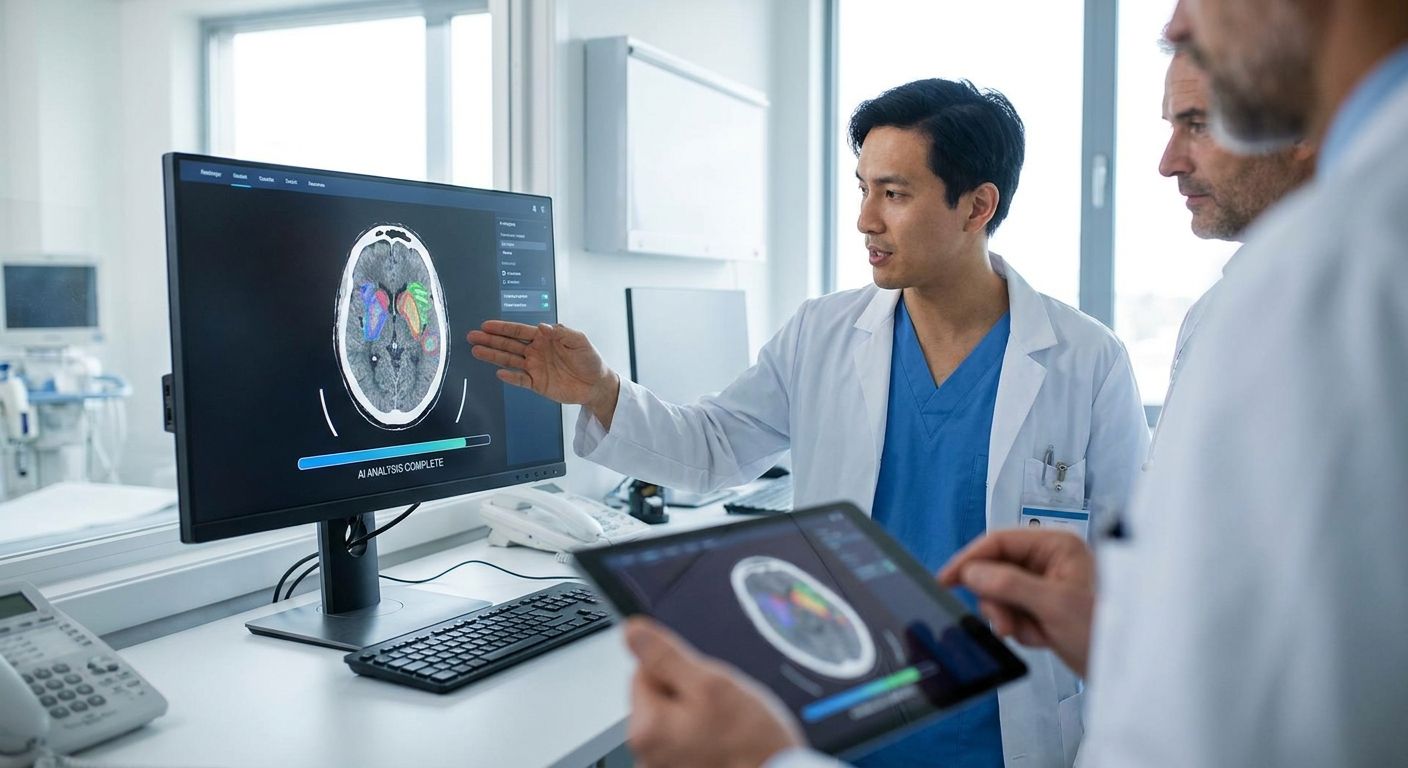
- Confirm a licensed radiologist reviews and signs every AI-flagged case — the AI narrows the queue, it does not issue the diagnosis
Hospitals evaluating this step often compare in-house AI licensing against a managed neuroradiology reporting service that bundles the triage software with the radiologist sign-off, so the flag and the final report come from the same accountable workflow instead of two separate vendors.
Route flagged scans to a specialist radiologist for sign-off
An AI flag without a radiologist's name on the final report is not a diagnosis — it's a heads-up. Hospitals that skip this distinction run into liability problems fast.
- Assign every flagged stroke scan to a radiologist with documented neuroradiology reporting experience
- Set a maximum queue depth per radiologist during stroke-code hours
- Require a structured report format for stroke cases (location, extent, ASPECTS score where applicable)
- Log sign-off time separately from AI-flag time so the two intervals are auditable independently
- Build a second-read protocol for equivocal cases before treatment decisions are finalized
Build escalation protocols for after-hours and rural sites
The biggest gap in most hospital stroke pathways isn't the AI — it's what happens when the primary on-call radiologist doesn't respond. Rural hospitals and standalone nursing homes feel this hardest because they often have no backup reader on staff.
- Define a maximum wait time before a case auto-escalates to a second radiologist
- Maintain a documented backup coverage list for nights, weekends, and holidays
- For satellite or rural sites, confirm image transmission works reliably before relying on it for stroke cases
- Run a quarterly test case through the full pathway, including the escalation step, to confirm it still works
- Document the escalation outcome for every case that triggers it, so patterns become visible over time
Hospitals without a radiology department on-site, including many rural facilities, depend entirely on this escalation layer working correctly — a stroke scan with no backup reader is a scan that sits unread.
Track outcomes and false-positive and false-negative rates
An AI tool that flags every scan as urgent is as useless as one that misses real cases. Hospitals need ongoing measurement, not a one-time validation study from the vendor.
- Track the false-positive rate against radiologist-confirmed findings monthly
- Track false negatives by reviewing a sample of non-flagged scans for missed pathology
- Compare flag-to-sign-off time month over month to catch workflow drift
- Correlate stroke pathway TAT against actual treatment outcomes where the data is available
- Share results with the radiology and ER teams jointly, not in separate silos
Train ER and radiology staff on the alert workflow
A tool nobody understands gets ignored within a month. Staff training determines whether the AI flag actually changes behavior at the bedside.
- Run a joint ER-radiology training session before go-live, not after
- Explain explicitly that the AI flag is a triage signal, not a diagnosis
- Post the escalation protocol somewhere visible in both the ER and reading room
- Retrain staff after any change to the tool, the vendor, or the reporting workflow
- Collect feedback from night-shift staff specifically — they hit the edge cases first
Get AI-assisted stroke pathway reviewed
See how flag-to-sign-off timing compares against your current stroke TAT.
Comparing your options for stroke imaging coverage
| Option | Best for | Key limitation |
|---|---|---|
| In-house on-call radiologist | Large hospitals with 24/7 in-house staffing | No coverage gap protection if the on-call radiologist is unreachable |
| Human-only teleradiology | Hospitals needing after-hours reads without AI triage | Queue still runs in order-received sequence; no automatic re-ranking for urgent cases |
| AI-only triage software | Hospitals that already have reliable in-house radiologist coverage | Flags a case but issues no signed report — still needs a radiologist for the diagnosis |
| AI-assisted teleradiology | Hospitals needing both fast triage and remote radiologist sign-off, especially multi-specialty hospitals and rural sites | Depends on stable image transmission from the originating site |
Verdict: for hospitals without guaranteed on-site neuroradiology coverage at all hours, AI-assisted teleradiology is the only option on this table that closes both the speed gap and the accountability gap in the same workflow.
Common mistakes hospitals make with stroke AI
- Treating the AI flag as the final report. A flagged scan with no radiologist sign-off is not documentation a hospital can defend in a chart review.
- Using one TAT target for all scans. Routine CT and stroke-code CT need separate SLAs; averaging them hides the real gap.
- No tested escalation path for after-hours cases. Many hospitals only discover their backup coverage doesn't work when the primary radiologist is unreachable during an actual stroke case.
- Skipping transmission testing at satellite and rural sites. A stroke pathway that depends on image transfer from a site with unreliable connectivity is only as fast as its weakest link.
- Reviewing AI performance once, at go-live, and never again. False-positive and false-negative rates drift as scanner protocols and patient mix change through 2026.
FAQ
What is AI-assisted stroke detection for hospitals?
It is a workflow where software flags CT or MRI scans showing signs of large-vessel occlusion or intracranial hemorrhage, then routes the flagged study to a radiologist for review and sign-off. The AI re-ranks the reading queue; the radiologist issues the actual diagnosis.
How fast should a stroke scan be reported?
Most stroke centers target under 30-45 minutes from scan acquisition to a signed radiologist report for suspected LVO cases. This target should be tracked separately from routine CT/MRI turnaround, since averaging the two hides the real gap.
Can AI diagnose a stroke without a radiologist?
No. AI triage software flags a scan as high-priority based on imaging patterns, but it does not issue a clinical diagnosis. A licensed radiologist reviews the flagged study and signs the final report before any treatment decision proceeds.
Is AI-assisted teleradiology better than human-only teleradiology for stroke cases?
For stroke specifically, yes, because AI triage re-ranks the worklist automatically so the stroke scan doesn't sit behind routine studies in queue order. Human-only teleradiology still processes cases in the order received unless a technician manually flags them.
What happens if the on-call radiologist doesn't respond to a flagged stroke scan?
Hospitals need a documented escalation protocol that reroutes the case to a backup radiologist after a defined wait time, commonly 15 minutes. Without this, a flagged scan can sit unread during exactly the window that matters most.
Do rural hospitals need a different stroke AI setup than city hospitals?
Rural and nursing-home sites usually lack on-site radiology coverage entirely, so their stroke pathway depends more heavily on reliable image transmission to a remote reading hub and a tested after-hours escalation chain than city hospitals with in-house staff.
How do hospitals measure if their AI stroke tool is working?
Track false-positive and false-negative rates monthly against radiologist-confirmed findings, and measure flag-to-sign-off time separately from scan-to-flag time. A tool validated once at go-live and never rechecked will drift as scanner protocols change.
Who signs off on AI-flagged stroke scans at 5C Network?
5C Network routes AI-flagged neuroradiology cases to specialist radiologists from its network of 400+ radiologists for final review and sign-off, serving hospitals across its base of 2,000+ partner facilities in 2026.
One last thing
The hospitals that get the most out of AI-assisted stroke detection in 2026 aren't the ones with the newest software — they're the ones that tested their after-hours escalation path before they needed it. A flag that reaches an unreachable radiologist is worse than no flag at all, because the case still shows up in the audit log as "triaged." Test the backup chain quarterly, not once at go-live.