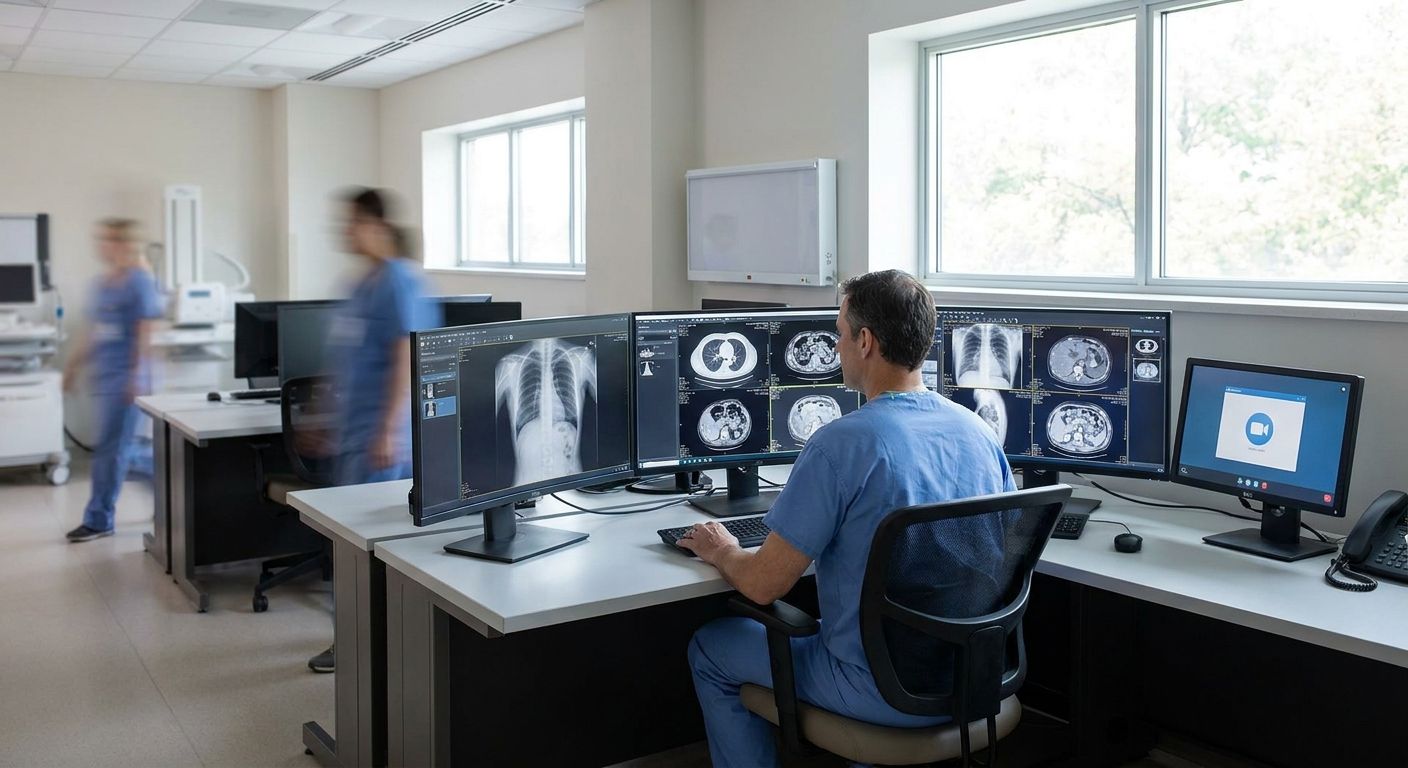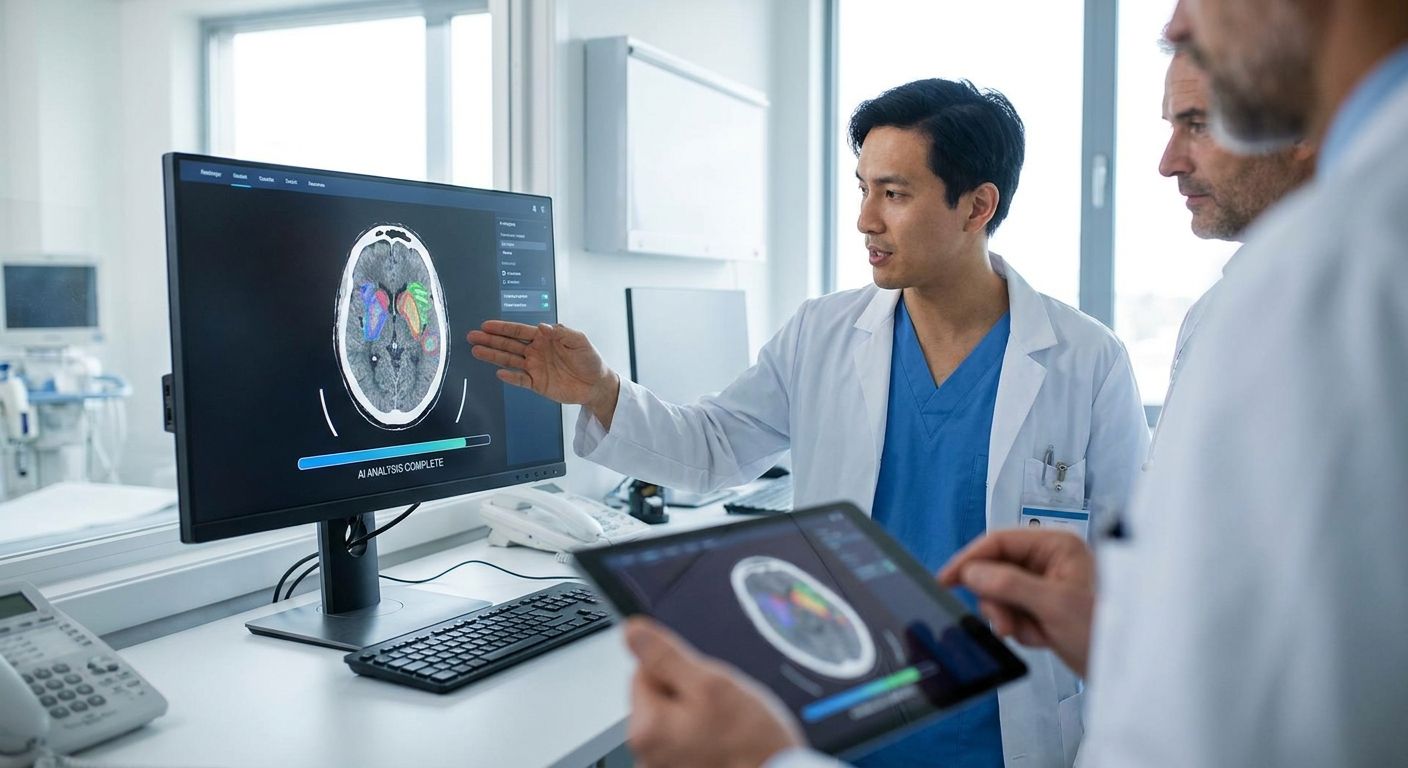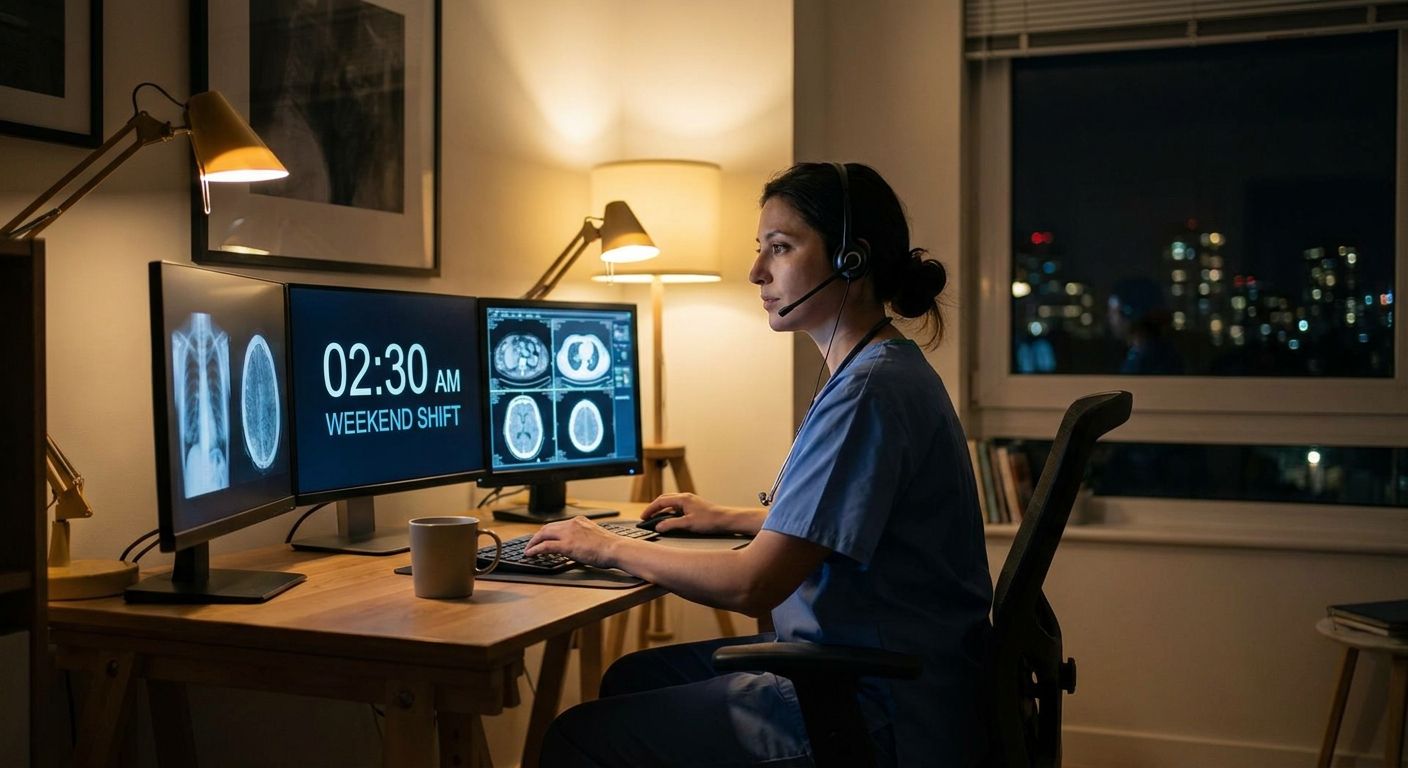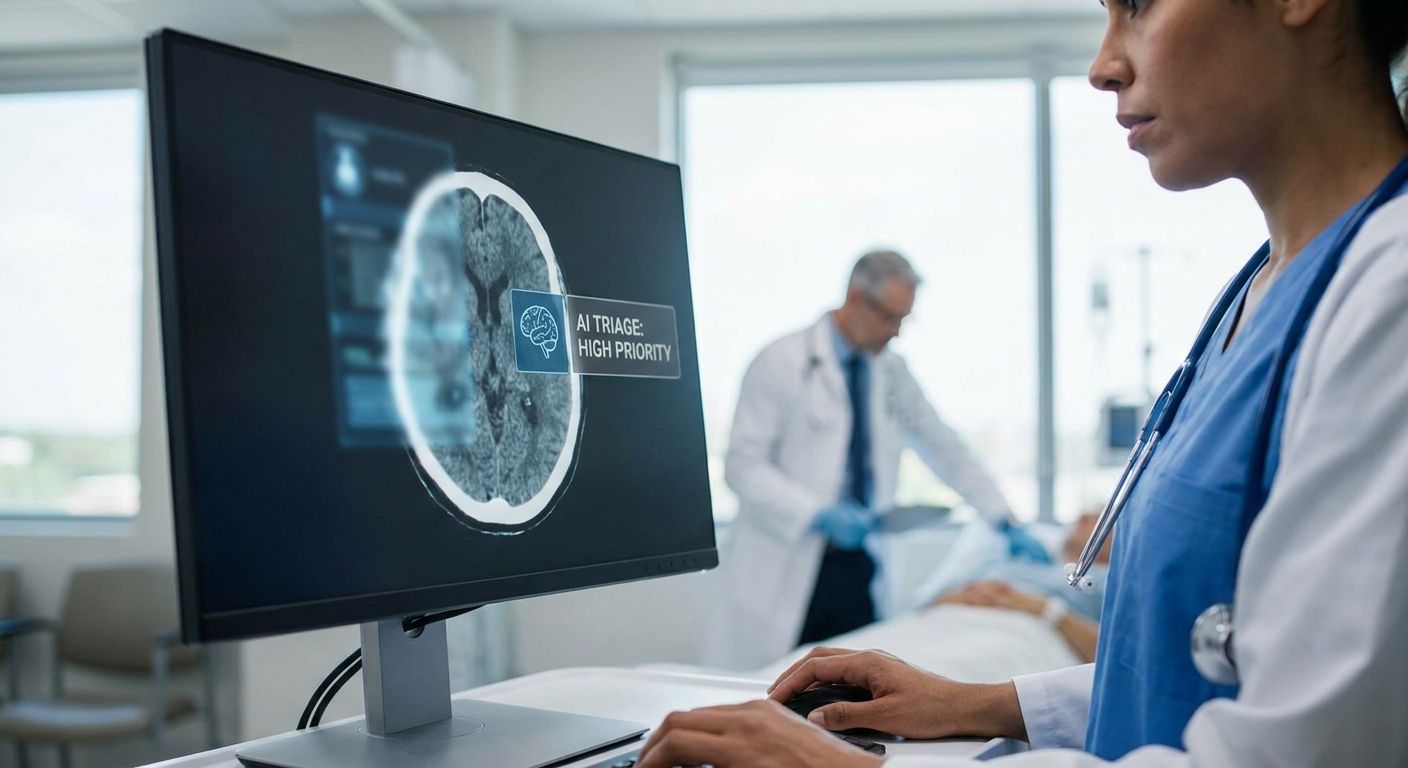
AI-assisted CT triage for emergency departments uses automated pathology detection to flag time-critical findings — large vessel occlusion, pulmonary embolism, active bleeds — before a radiologist opens the study, so the ED acts on the scan that needs a decision in minutes, not the one that can wait until morning.
- AI-assisted CT triage for emergency departments flags LVO, PE, and active bleeds before radiologist review — 5C Network runs this across 2,000+ hospitals.
- Manual triage alone can't scale past a busy night shift; AI flagging plus radiologist sign-off closes that gap.
- 5C Network's Bionic AI models support stroke, cardiac, and trauma CT triage with sign-off from 400+ radiologists.
- Best for EDs without 24/7 in-house radiology coverage — it's a priority signal, not a replacement for the final read.
Why AI-assisted CT triage matters for emergency departments
An ED radiology queue treats every CT the same way by default — first in, first read. That works until a shift stacks a stroke workup, a trauma pan-scan, and three outpatient follow-ups in the same window, and it breaks completely at a rural hospital running a busy ED without a radiologist on-site overnight.
Stroke protocols run on a clock: current guidelines target door-to-needle inside 60 minutes for eligible tPA candidates, and every minute a large vessel occlusion sits unread pushes that window closer. A pulmonary embolism on CTPA or a bleed on a head CT carries the same urgency — the scan exists, nobody has opened it yet.
AI-assisted CT triage for emergency departments in 2026 doesn't diagnose. It re-orders the queue so the radiologist opens the stroke, the bleed, or the PE first and reads the ankle-fracture follow-up after. For an ED running high CT volume without in-house radiology coverage on every shift, that re-ordering is what keeps a critical scan from sitting behind five routine ones.
Map your CT triage bottleneck before adding AI
Before any triage tool touches your queue, find where scans actually stall: acquisition-to-read, read-to-report, or report-to-clinician notification. AI-assisted CT triage fixes the middle stage; it does nothing for a tech backed up on the scanner or a resident who doesn't check the PACS inbox.
- Time-stamp scan completion, radiologist open, and final sign-off for one full week of ED CT volume
- Separate stroke, PE, and trauma studies from routine outpatient-referred CTs in that log
- Flag any study where read time exceeded 30 minutes and note the reason
- Check whether delays cluster on night shifts, weekends, or specific radiologist rotations
- Confirm your PACS/RIS can actually surface an AI flag to the reading radiologist's worklist
Build a critical-findings escalation protocol
A flag nobody sees isn't triage — it's noise. Before any AI tool goes live, define who gets called, how fast, and what counts as "critical" for your ED's specific case mix.
- Write a critical-findings list specific to your ED (LVO, active hemorrhage, tension pneumothorax, free air, aortic dissection)
- Assign a named escalation contact per shift, not just "the on-call radiologist"
- Set a maximum acceptable time from flag to phone call or direct message
- Document the fallback when the escalation contact doesn't respond in that window
- Review every escalation monthly against the list — pathologies get added or dropped based on real misses
Deploy AI-assisted flagging on high-acuity CT studies
This is where a teleradiology partner with AI-assisted analysis replaces a purely manual queue. 5C Network runs Bionic, its AI model set, across incoming CT studies from more than 2,000 hospitals, surfacing suspected LVO, active bleeds, and other time-sensitive findings to the worklist before a radiologist opens the case. By 2026 most validated AI triage models cover a narrow pathology set — the radiologist still makes the call, the AI just moves the study up.
- Confirm which pathologies the AI model is validated for — stroke and hemorrhage triage isn't the same model as pulmonary nodule detection
- Set the flag threshold with your radiology partner so sensitivity doesn't bury the worklist in false positives
- Keep a licensed radiologist as the mandatory second step on every flagged study — AI-assisted analysis, not AI sign-off
- Pilot on one pathology, stroke for instance, before expanding to cardiac or trauma triage
- Log every AI flag against the final radiologist diagnosis from day one, not after a complaint
Route stroke and neuro CT through a dedicated read pathway
Stroke and neuro trauma CTs need a separate lane from routine ED imaging — bundling them with fracture and appendicitis follow-ups guarantees they wait their turn in a first-in-first-out queue.
- Create a dedicated worklist category for suspected stroke, neuro trauma, and intracranial hemorrhage
- Route these studies through a neuroradiology reporting service or a radiologist subspecialized in neuro imaging when volume supports it
- Set a shorter acceptable read-time target for this category than for general ED CT
- Track door-to-needle time separately from overall ED radiology turnaround
- Audit missed LVOs and hemorrhages quarterly against the AI flag log
Give cardiac and PE studies a fast lane too
Aortic dissection, PE on CTPA, and acute cardiac findings move on a clock close to stroke's, and they get missed in EDs that built a fast lane only for neuro cases.
- Build a second dedicated queue for CTPA and cardiac CT alongside the stroke lane
- Route cardiac CT reads through a cardiac CT reporting service or a radiologist with cardiac subspecialty sign-off
- Confirm your AI triage model actually flags PE and dissection, not just neuro pathology
- Apply the same named-escalation-contact rule from the protocol step to this queue
Set sign-off rules for AI-flagged cases
An AI flag is a prioritization signal, not a report. Every flagged study still needs a radiologist's final sign-off before it becomes actionable for the ED team.
- Require a licensed radiologist to review and sign every AI-flagged study, no auto-release
- Log AI flag versus final radiologist diagnosis to track agreement rate over time
- Define what happens when the radiologist disagrees with an AI flag — does the case get a second read?
- Confirm your reporting partner's sign-off radiologists are named and credentialed, not anonymous
Track turnaround and false-positive rate after go-live
AI-assisted CT triage only earns its place in the ED workflow if it's measurably faster and isn't drowning staff in false alarms.
- Compare flag-to-read time before and after AI triage went live
- Track false-positive rate on flagged studies monthly, broken out by pathology type
- Watch for alert fatigue — if radiologists start ignoring flags, the threshold is wrong
- Re-benchmark turnaround quarterly against your original bottleneck map from step one
Comparison: CT triage options for emergency departments
| Option | Best for | Key limitation |
|---|---|---|
| In-house radiologist-only reads | EDs with 24/7 on-site radiology coverage | No AI-assisted prioritization; volume spikes still queue first-in-first-out |
| Generic teleradiology, no AI triage | Low-volume EDs needing occasional overflow reads | Critical findings sit in the same queue as routine studies |
| AI-assisted teleradiology (5C Network) | High CT-volume EDs without overnight in-house radiology, including multi-specialty hospitals | AI flags support prioritization; final diagnosis still requires radiologist sign-off |
| On-site AI triage software only | Large tertiary EDs with an existing in-house radiology group | Doesn't solve after-hours or overflow coverage gaps on its own |
5C Network's AI-assisted CT triage in 2026 is built for EDs that run high scan volume without a radiologist physically on-site every shift — not for replacing the final radiologist read.
Get AI-assisted CT triage for your ED
Route high-acuity CT studies through 5C Network's Bionic AI and radiologist sign-off.
Common mistakes EDs make with AI-assisted CT triage
- Treating an AI flag as a diagnosis. The flag says "look at this next," not "this is confirmed" — skipping radiologist sign-off on a flagged study is a compliance and safety problem, not a shortcut.
- No named escalation contact per shift. "Call the on-call radiologist" fails at 3 a.m. when nobody on the floor knows who that is without checking a roster.
- Running one queue for trauma and outpatient follow-ups. Without a separate stroke and cardiac lane, AI flags just move a study up a few slots in a queue that's still too long.
- Never auditing false positives. A threshold set once at go-live in 2026 and never revisited either buries radiologists in noise or quietly misses real findings months later.
- Skipping night and weekend protocols. CT volume doesn't drop after hours in most EDs, but staffing does — the queue that needs AI triage most is exactly the one that gets the least attention.
FAQ
What is AI-assisted CT triage in an emergency department?
AI-assisted CT triage is software that scans completed CT studies and flags time-sensitive findings — stroke, active bleeds, PE — so a radiologist reads the highest-acuity case first instead of working through the queue in scan order. It reorders priority; it doesn't replace the radiologist's read.
Does AI-assisted CT triage replace the radiologist?
No. AI flags a study for faster review; a licensed radiologist still reads the scan and signs the final report. 5C Network's Bionic AI models support this workflow with sign-off from 400+ specialist radiologists.
How fast should a stroke CT be reported in an ED?
Current stroke guidelines target a door-to-needle time under 60 minutes for eligible tPA candidates, which means the CT read itself needs to happen well inside that window. AI-assisted triage is built to cut the time between scan completion and radiologist review for exactly this reason.
Can AI triage flag incidental findings on trauma CT?
Some AI models flag incidental findings alongside the primary trauma indication, but validated pathology coverage varies by model. Confirm with your teleradiology partner which findings their AI is actually validated to detect before relying on it for incidentals.
Is AI-assisted CT triage the same as teleradiology?
No. Teleradiology is remote scan reporting by radiologists; AI-assisted triage is a layer on top that reorders which scans those radiologists read first. 5C Network combines both — remote reporting across 2,000+ hospitals with AI triage built into the workflow.
How does 5C Network support ED CT triage?
5C Network runs its Bionic AI models across incoming CT studies to flag time-sensitive findings, then routes flagged cases to specialist radiologists among its network of 400+ for sign-off, working toward a standard 30-minute turnaround target for urgent studies.
What happens if an AI flag turns out to be a false positive?
The radiologist still reviews the flagged study and reports what's actually on the scan. A false-positive flag costs a few extra minutes of review, not a missed diagnosis, which is why sign-off stays with the radiologist and not the algorithm.
Does AI triage cover MRI and X-ray, not just CT?
AI-assisted triage models are typically pathology- and modality-specific, so a CT stroke model doesn't automatically cover X-ray or MRI. Check which modalities and pathologies your teleradiology partner has validated before assuming coverage extends beyond CT.
One last thing
The EDs getting the most out of AI-assisted CT triage in 2026 aren't the ones with the fanciest model — they're the ones that audited their escalation protocol first. A flag that reaches a radiologist's worklist in seconds is worthless if the named on-call contact takes 40 minutes to pick up the phone. Fix the human handoff before you judge the algorithm.