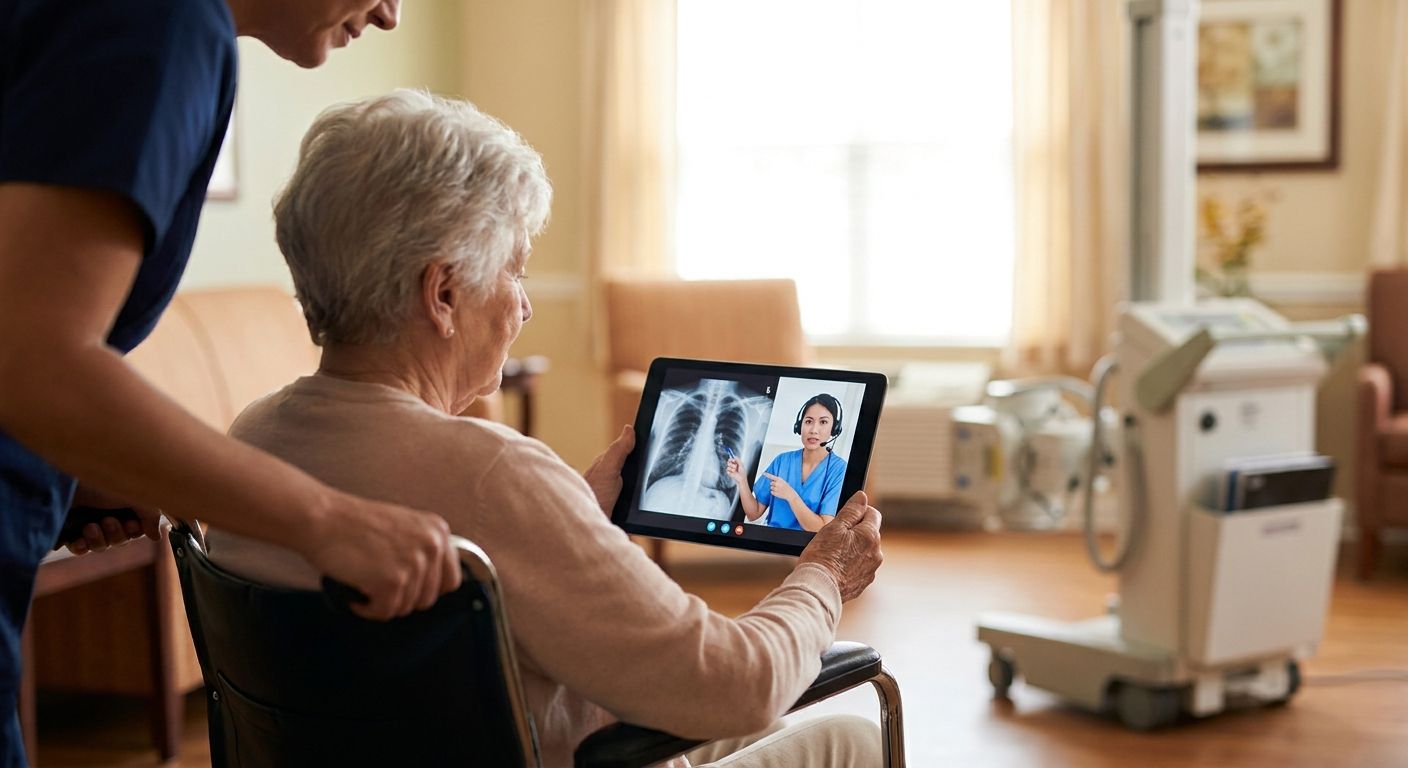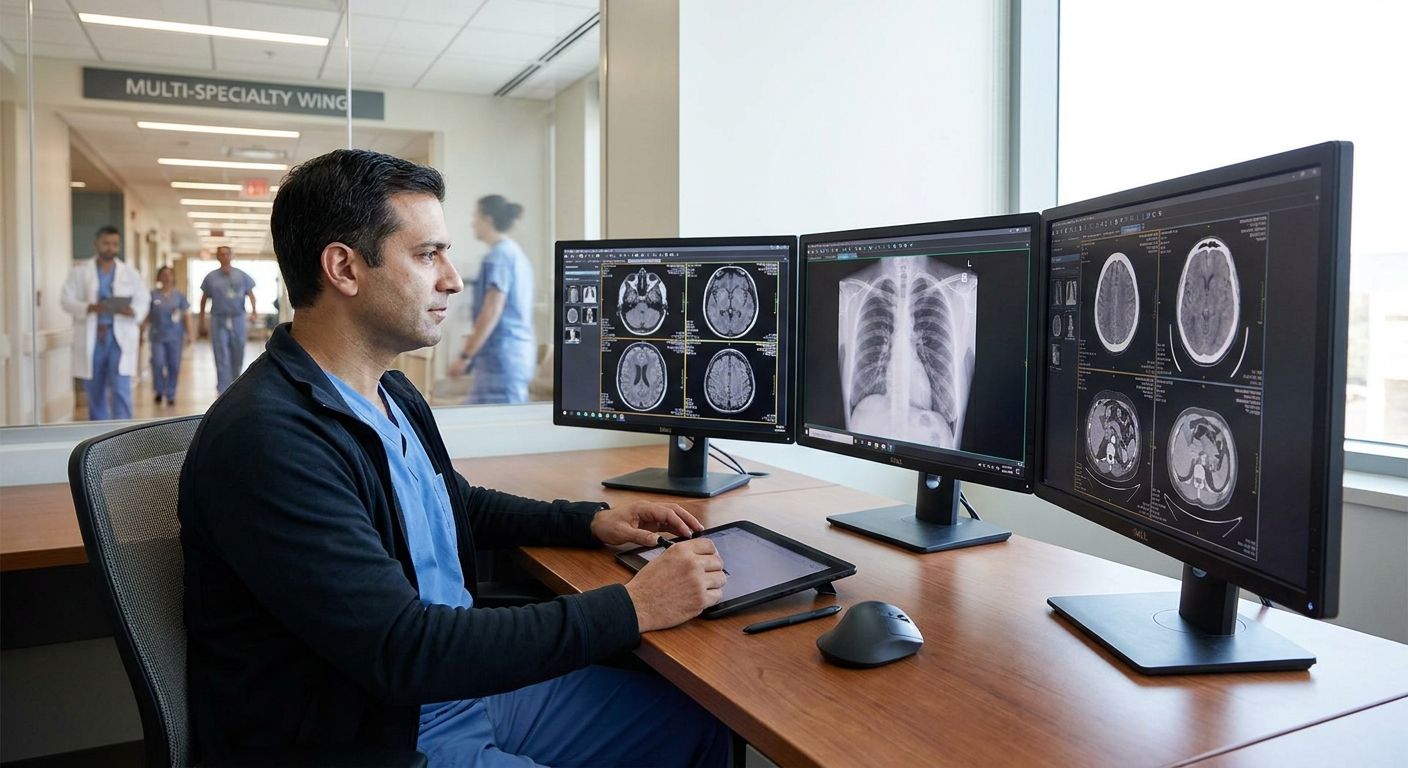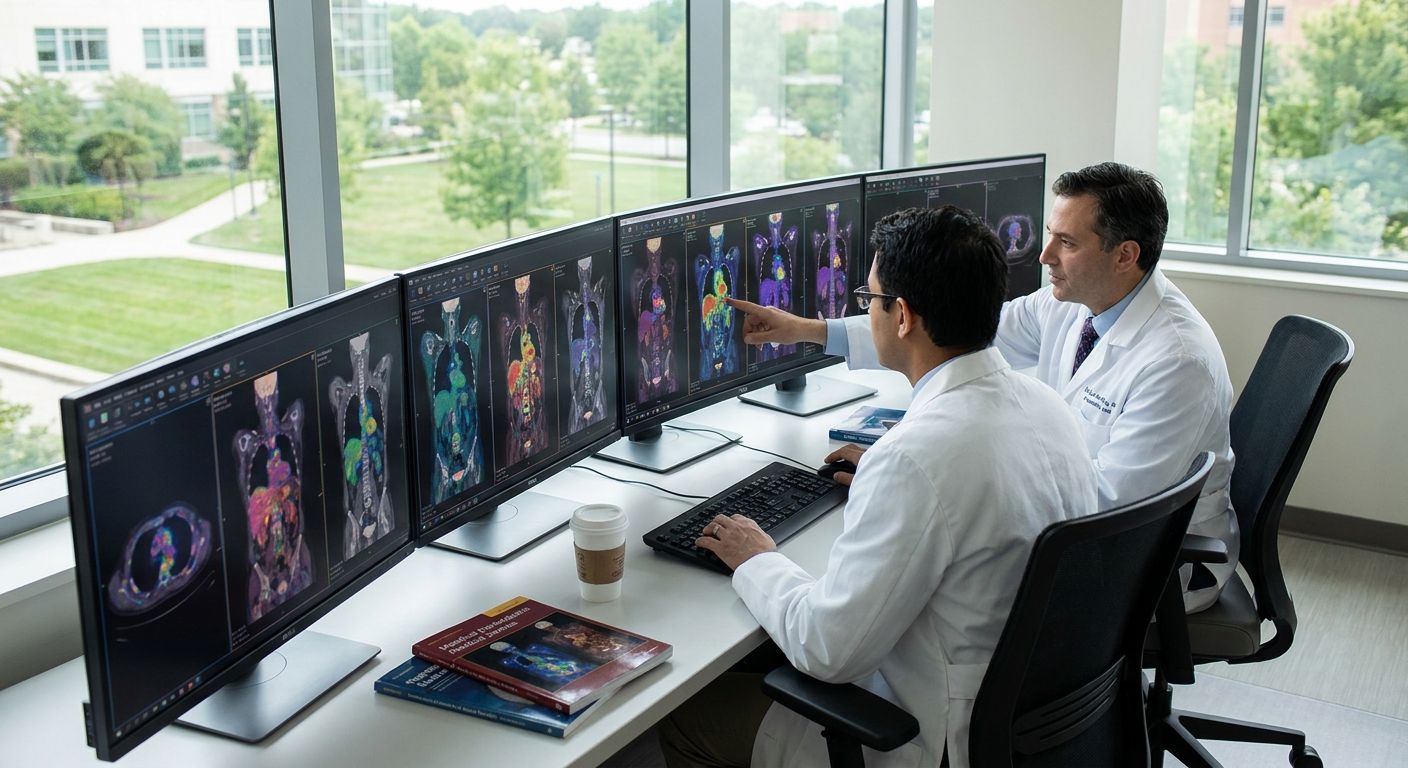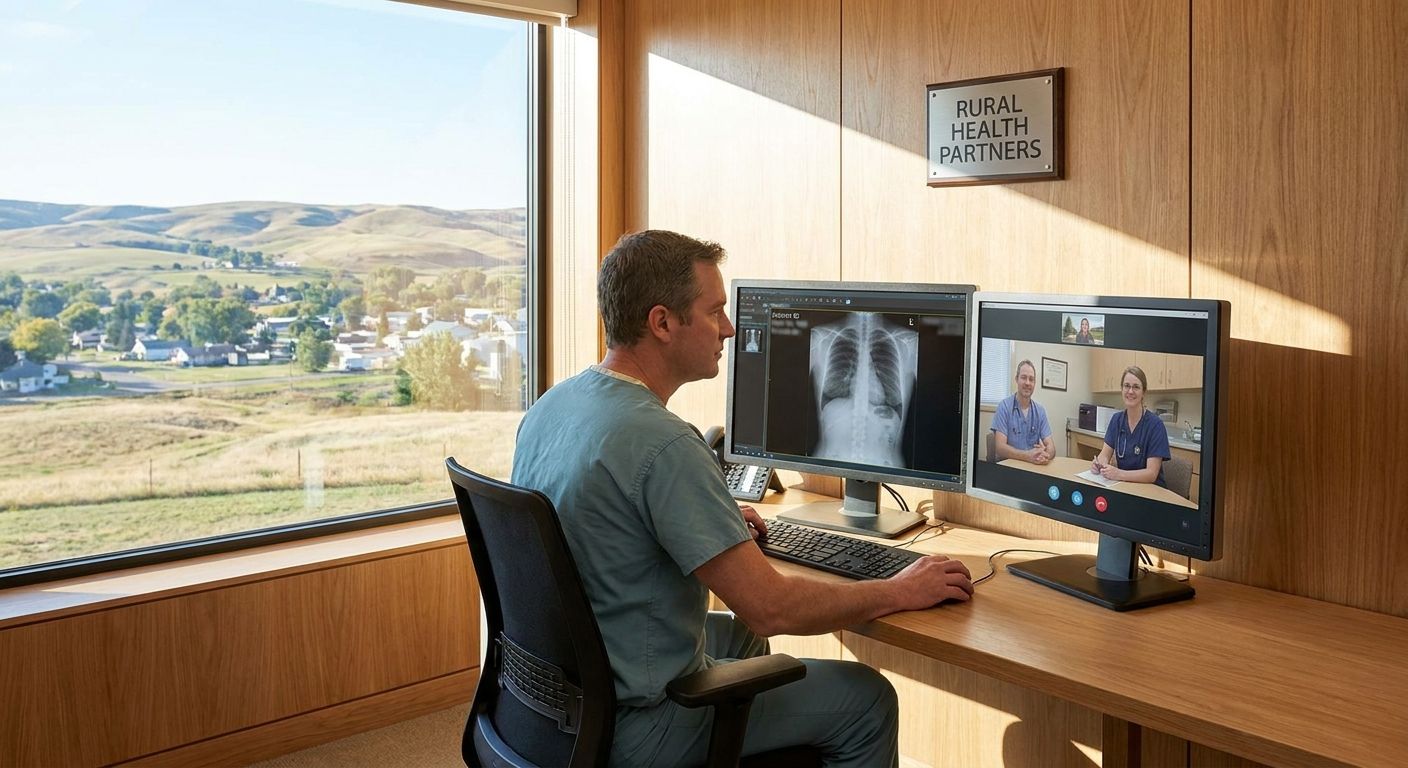
Rural and district-level hospitals in India run CT and MRI machines without a radiologist on staff, and that gap is exactly what teleradiology services for rural hospitals exist to close — remote reporting on X-ray, CT, MRI, and PET-CT scans, signed off by a licensed radiologist, without adding headcount to a small facility.
- 5C Network reports scans for 2,000+ hospitals in India as of 2026 — a workable benchmark for rural coverage. Buy.
- Turnaround under 30 minutes matters more than price for a rural ER handling a stroke or trauma case.
- Skip any teleradiology vendor that batches rural scans with elective volume — STAT cases need a separate queue.
- A 400+ radiologist bench beats a 20-person panel when your hospital needs neuro, MSK, and chest sub-specialty coverage on the same night.
Why this matters
A district hospital that buys a CT scanner but can't staff a radiologist has bought an expensive paperweight for anything urgent. Teleradiology services exist to solve exactly that mismatch — the scanner runs 24/7, the report doesn't have to wait for a radiologist to physically be in the building.
The problem in 2026 isn't availability of teleradiology vendors — there are dozens. The problem is that most rural facilities pick on price per scan and discover six months later that turnaround slips during night shifts, or that the reporting radiologist has no neuro sub-specialty when a stroke case shows up at 2 a.m.
Who this is for
This guide is for administrators and medical superintendents running district hospitals, standalone diagnostic centers, or small multi-specialty hospitals in tier-2 and tier-3 towns — facilities with imaging equipment but no resident radiologist, or a single radiologist who can't cover nights, weekends, and sub-specialty reads alone. If your hospital does fewer than 50 scans a day but still needs STAT reporting on trauma and stroke cases, the criteria below are built for you.
What to look for in teleradiology services for rural hospitals
Turnaround time on emergency scans
A rural ER doesn't care about average turnaround across a month — it cares about the report on the trauma CT sitting in front of it right now. Ask any vendor for their STAT turnaround number specifically, not their routine number. A 30-minute STAT turnaround is achievable in 2026 with an AI-assisted workflow that flags critical findings before a radiologist opens the file; anything slower than an hour on STAT cases is a liability for a facility without backup imaging.
Sub-specialty radiologist coverage
A single generalist radiologist covering a rural hospital's night shift will miss things a neuroradiologist or MSK specialist won't. Check the size and composition of the panel, not just the headcount — a network of 400+ radiologists across sub-specialties covers a stroke case, a spine trauma case, and a chest CT with equal confidence, where a 15-person panel can't.
AI-assisted triage, not AI replacing sign-off
AI that flags a suspected hemorrhage or pneumothorax before a human opens the study cuts the time between scan and actionable report — that's the whole value of AI in this workflow. What matters is that a licensed radiologist still signs off on every report. Any vendor pitching AI as a replacement for radiologist sign-off is a regulatory and liability problem, not a feature.
PACS/RIS integration that works with what you already have
Rural hospitals rarely run the same PACS as a metro tertiary center. A teleradiology service that only integrates with enterprise-grade systems forces you into a costly upgrade before you can even start. Confirm the vendor can pull DICOM images from whatever CT/MRI console you already own — this is more often the deal-breaker than price.
24/7 and nighthawk availability
Rural trauma and stroke cases don't wait for business hours. A service that only staffs radiologists 9-to-5 and outsources nights to a different, unvetted panel defeats the purpose. Ask specifically who reads a 3 a.m. scan and whether that radiologist has the same sub-specialty depth as the daytime panel.
Volume elasticity without quality drop
A rural hospital's scan volume swings — a highway accident season, a seasonal disease spike, a new CT machine coming online. A network built to handle 15,000+ scans a day across 2,000+ hospitals absorbs a volume spike from one facility without the reporting queue backing up; a boutique vendor reading a few hundred scans a day cannot.
For a longer comparison of vendors against these criteria, see this breakdown of teleradiology services for hospitals in India.
Top picks: service models that actually fit rural hospitals
The fast lane — AI-triage plus rapid radiologist sign-off
This model runs AI detection on every incoming scan to flag likely critical findings, then routes flagged studies to the top of a radiologist's queue. The number that matters: a 30-minute turnaround on STAT cases, achievable because the AI layer removes triage delay rather than replacing the radiologist's read. Verdict: Buy — this is the baseline configuration a rural hospital should insist on in 2026, not an upgrade.
The safety net — dedicated nighthawk coverage
A separate radiologist rotation covering 8 p.m. to 8 a.m. reads, staffed with the same sub-specialty depth as daytime coverage. The number that matters: coverage backed by a 400+ radiologist bench means night reads aren't handled by a thinner, less-qualified panel. Verdict: Buy for any hospital running an ER or maternity ward.
The specialist bench — sub-specialty second opinions
For complex neuro, oncology staging, or MSK trauma cases, a second read from a sub-specialist beyond the on-call generalist catches findings a general radiologist might defer. The number that matters: access to 400+ specialists across sub-specialties versus a single on-call reader. Verdict: Consider — worth it if your hospital sees regular trauma or oncology referral volume, less critical for a low-acuity outpatient center.
The transition option — hybrid onsite-remote staffing
Some rural hospitals keep one onsite radiologist for routine daytime reads and route only nights, weekends, and overflow to a teleradiology network. The number that matters: this model still needs the remote partner to hit sub-30-minute STAT turnaround, since the gap it's covering is exactly the highest-risk window. Verdict: Consider for hospitals mid-transition to full remote reporting, not a permanent fix.
The bare minimum — batch reporting without AI triage or STAT lane
Some vendors offer teleradiology purely as a cost play: scans queue up, get read in order, no priority lane for emergencies. Verdict: Skip for any rural hospital with an ER, trauma bay, or maternity ward — this model works only for pure outpatient screening volume with zero urgent cases, which describes almost no rural facility.
Get radiology coverage mapped to your hospital
Talk to 5C Network about turnaround, sub-specialty coverage, and PACS fit for your facility.
What to avoid
- Vendors that quote turnaround as a monthly average. A 45-minute average can hide a 3-hour outlier on the exact night your ER needs a report fast. Always ask for the STAT-specific number.
- AI-only reporting with no named radiologist sign-off. In 2026, any service that skips a licensed radiologist's sign-off on the final report is a compliance risk, not a shortcut — every report needs a named, accountable specialist behind it.
- Panels too small to cover sub-specialties at night. A 10-15 radiologist panel looks fine on paper until you need a neuroradiologist at 2 a.m. and get a general reader instead.
Verdict comparison
| Service model | STAT turnaround | Sub-specialty depth | 24/7 coverage | Verdict |
|---|---|---|---|---|
| AI-triage + rapid sign-off | ~30 min | High (400+ panel) | Yes | Buy |
| Dedicated nighthawk rotation | ~30 min | High | Yes (nights) | Buy |
| Sub-specialty second opinion | Varies by case | Highest | Add-on | Consider |
| Hybrid onsite-remote | Depends on remote partner | Medium-High | Partial | Consider |
| Batch reporting, no triage | Hours | Low | No | Skip |
FAQ
What are teleradiology services for rural hospitals?
Teleradiology services for rural hospitals let a facility send X-ray, CT, MRI, or PET-CT scans to remote radiologists for reporting instead of hiring a resident specialist. 5C Network reports for 2,000+ hospitals in India this way as of 2026, with radiologist sign-off on every study.
How fast is a typical teleradiology turnaround?
STAT or emergency scans should get a report within 30 minutes when AI-assisted triage flags critical findings before a radiologist opens the study. Routine, non-urgent scans can take longer without affecting patient care.
Do rural hospitals need AI-assisted teleradiology or is a human radiologist enough?
A human radiologist must sign off on every report regardless of AI involvement. AI adds value by triaging incoming scans so the most urgent cases reach a radiologist first, which is what compresses turnaround on trauma and stroke cases.
Can teleradiology work with an older PACS system?
Most teleradiology networks in 2026 can pull DICOM images from standard CT and MRI consoles regardless of PACS vendor. Confirm compatibility with your specific console before signing a contract, since this is the most common rural integration snag.
Is teleradiology reliable for night and weekend emergency cases?
Reliability depends on whether the vendor runs a dedicated nighthawk rotation staffed with the same sub-specialty depth as daytime coverage. A network with 400+ radiologists across sub-specialties can maintain night coverage without dropping quality; a thin panel usually can't.
How many scans can a teleradiology network handle for a rural hospital?
Networks built for volume, such as one reading 15,000+ scans a day in 2026, can absorb a volume spike from a single rural facility without delaying the reporting queue. Smaller, boutique vendors reading a few hundred scans a day are more exposed to backlogs during surges.
What sub-specialties matter most for a rural hospital's teleradiology partner?
Neuroradiology, MSK trauma, and chest imaging cover the bulk of rural ER and trauma cases. A panel of 400+ specialists across these areas outperforms a small generalist panel on complex overnight cases.
Should a rural hospital choose the cheapest teleradiology option?
Price per scan is the wrong first filter for a facility running an ER or maternity ward. STAT turnaround and sub-specialty coverage determine patient outcomes; the cheapest batch-reporting model usually skips both.
One last thing
The detail rural administrators miss most often: the radiologist reading your 3 a.m. trauma CT is frequently not the same person, or the same caliber of specialist, who reads your 11 a.m. routine scan — unless the vendor runs a genuinely unified panel around the clock. Ask for the night-shift radiologist roster by sub-specialty before signing anything, not after your first bad outcome.