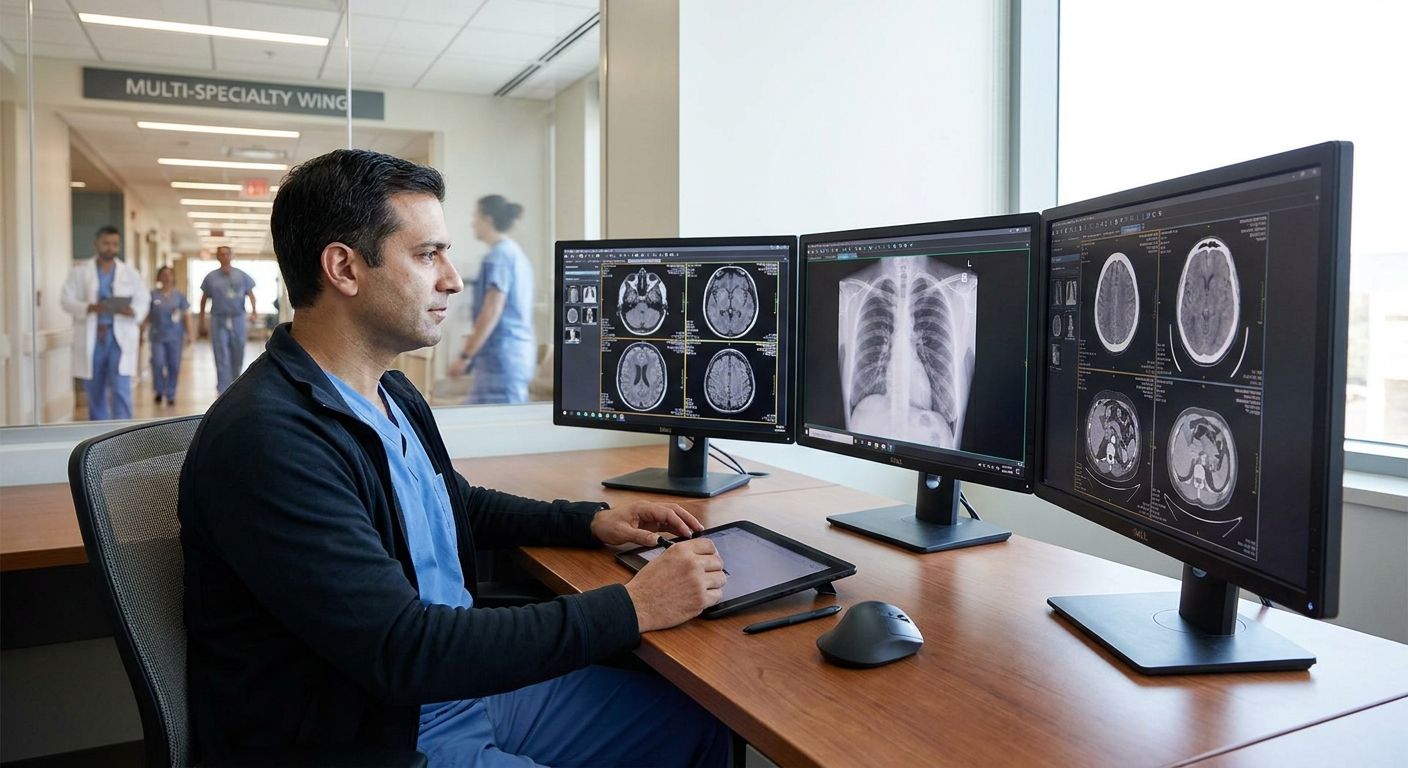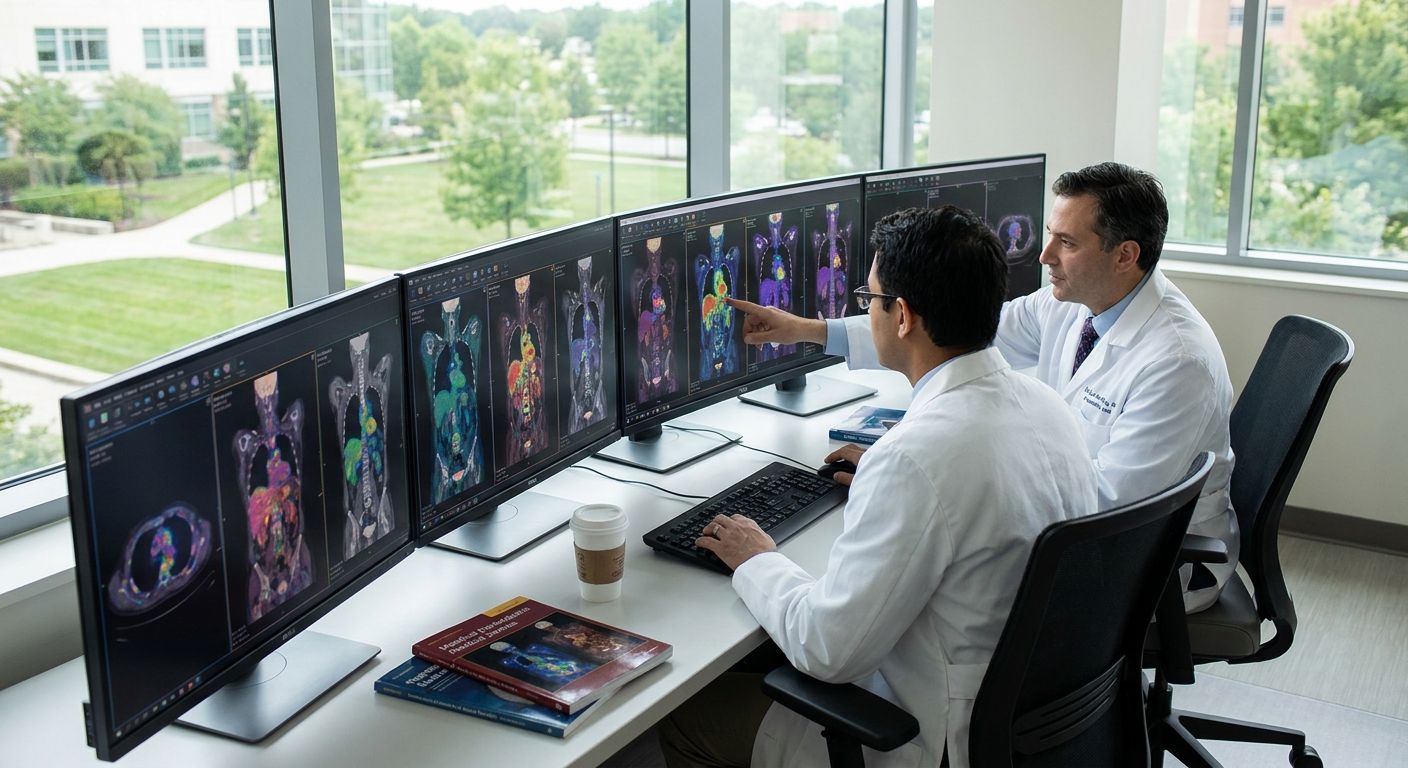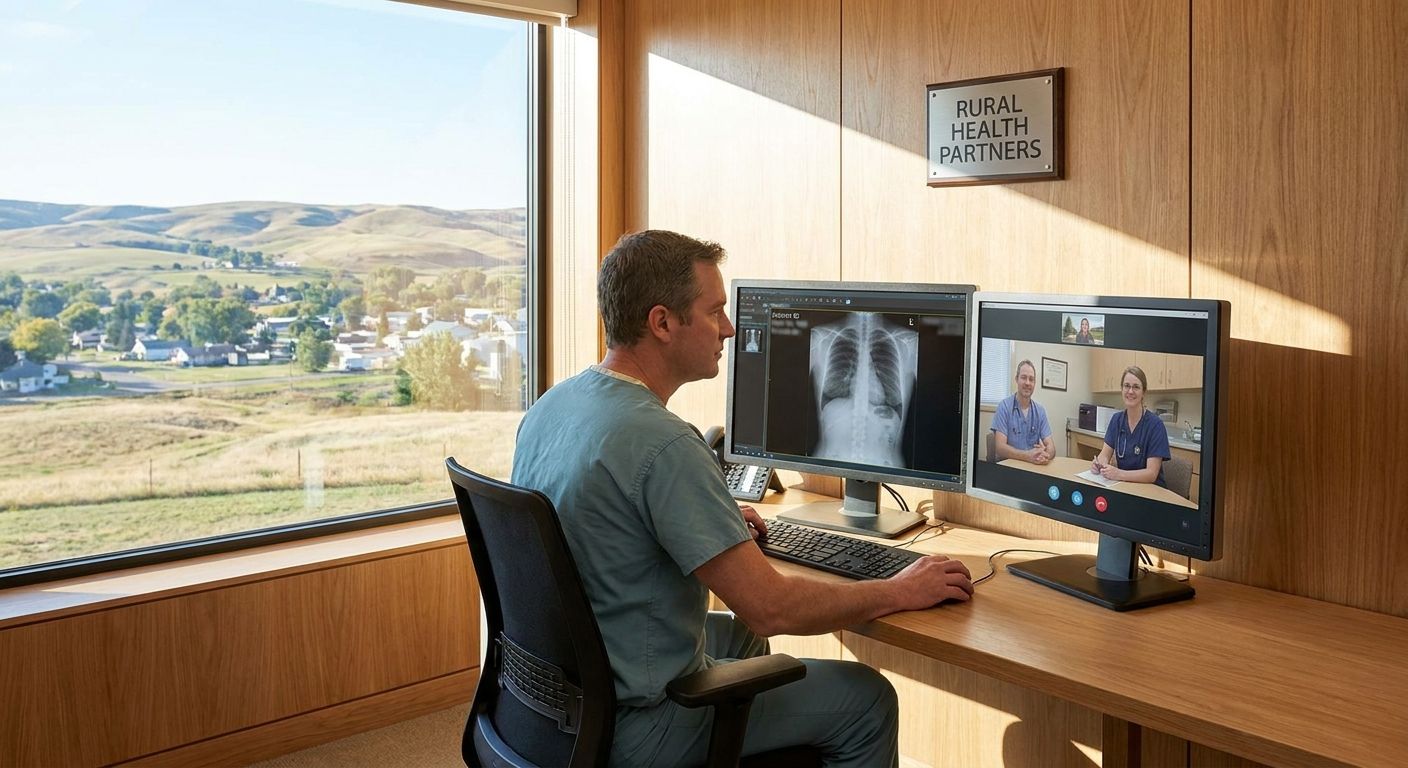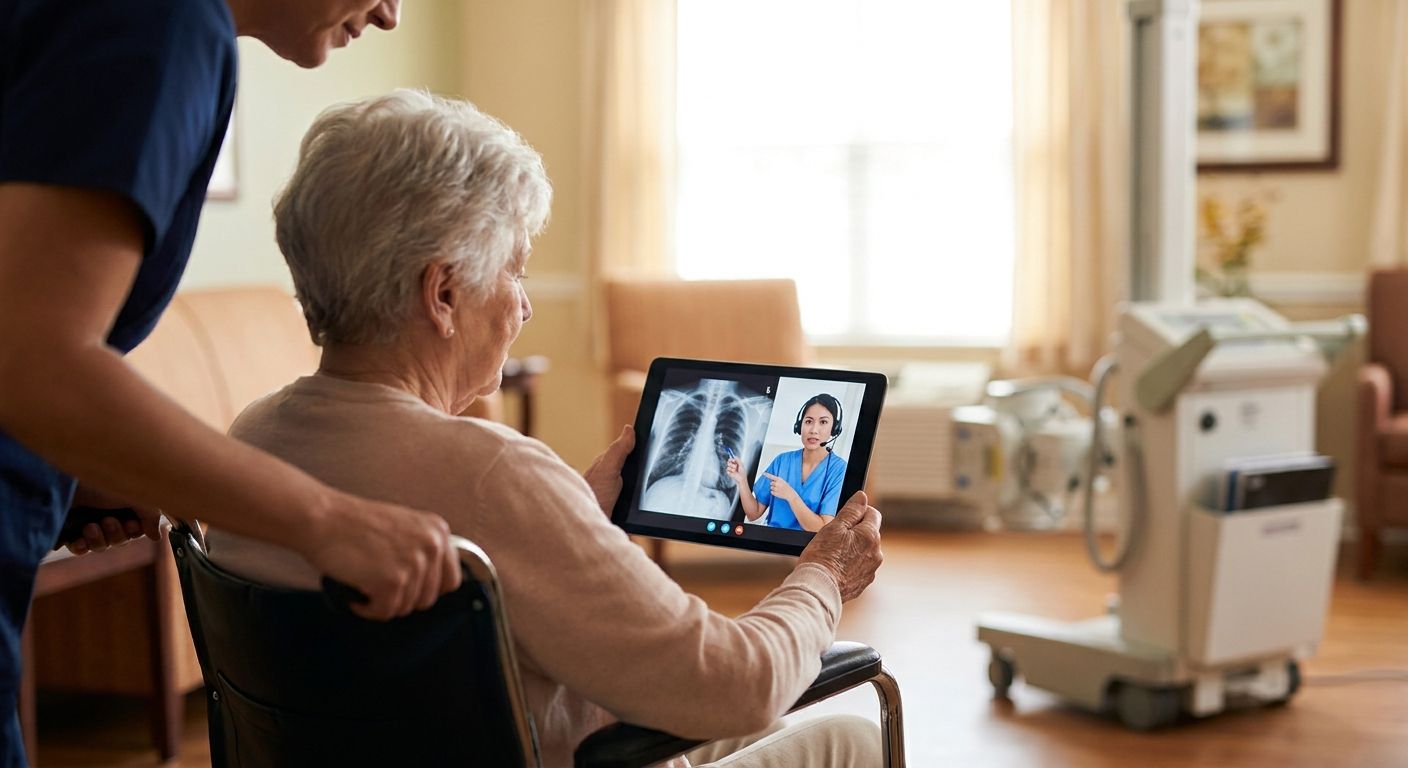
Nursing homes and assisted living facilities in India rarely keep a radiologist on staff, yet a resident who falls at 1 a.m. still needs an X-ray read before the night shift decides whether to send them to the ER. Teleradiology services for nursing homes exist to close that gap — a remote radiologist network reads the scan and signs a report on a fixed turnaround, regardless of the hour.
- 5C Network covers 2,000+ hospitals and diagnostic centers in India — buy it for facilities needing 24/7 X-ray coverage.
- Skip AI-only reporting with no radiologist sign-off; elderly fracture and stroke cases need a named clinician on record.
- Teleradiology services for nursing homes work best when turnaround holds near 30 minutes for STAT falls in 2026.
- Match modality coverage to referral patterns: X-ray-only facilities need a different setup than CT or PET-CT referral hubs.
Why this matters
Most nursing homes generate somewhere between 5 and 20 imaging referrals a week — not enough volume to justify hiring a radiologist, but enough that a missed hip fracture or a delayed pneumothorax turns into a liability fast. Teleradiology services for nursing homes solve that volume mismatch: a remote radiologist network absorbs the fluctuation and reads a 2 a.m. fall the same way it reads a 2 p.m. referral.
5C Network runs this model across 2,000+ hospitals and diagnostic centers in India, reporting through 400+ specialist radiologists who sign off on X-ray, CT, MRI, and PET-CT studies at a combined volume of 15,000+ scans a day. For a nursing home administrator in 2026, the number that actually matters is turnaround — a report that lands in 30 minutes changes whether a resident goes to the ER tonight or waits for morning rounds.
Who this is for
This guide is for nursing home administrators, assisted living operators, and sub-acute rehab facility owners who refer imaging to a local diagnostic center but have no radiologist on staff to interpret it fast. It fits facility owners running one to three locations with irregular scan volume, and chains evaluating whether to centralize reporting across sites instead of negotiating with a different local radiologist at each one.
What to look for in teleradiology for nursing homes
Turnaround time for after-hours reads
Falls and aspiration events at nursing homes happen disproportionately overnight, when the local diagnostic center has no radiologist on-site. A provider quoting a 30-minute STAT turnaround for X-ray means a fracture gets confirmed and treated before the next shift change, not after.
Modality coverage across X-ray, CT, MRI, and PET-CT
Most nursing home referrals are plain X-ray, but stroke workups need CT and oncology follow-up in sub-acute rehab needs PET-CT. A provider that stops at X-ray forces the facility to source a second vendor for the harder cases — which defeats the point of consolidating reporting in the first place.
Radiologist sign-off, not AI-only output
AI can flag a probable fracture or a possible bleed in seconds, but a facility needs a named specialist's signature on the final report, not a confidence score from a model. 5C Network pairs AI-assisted analysis with sign-off from its 400+ radiologists, so the document a family or an insurer sees carries a clinician's name, not just an algorithm's output.
Volume flexibility without hospital-scale minimums
A facility reporting 8 scans one week and 22 the next needs pricing and contracts built for that swing, not a per-scan minimum designed for a 300-bed hospital's radiology department.
AI-assisted flagging for critical findings
A fracture, an intracranial bleed, or a pneumothorax on a resident's scan should surface to the reporting radiologist before the full report is typed out — not as an afterthought once the queue clears.
Which teleradiology setup fits your facility
The nighttime safety net — for a single nursing home that sees off-hours fall referrals more than twice a month. Spec that matters: a 30-minute STAT turnaround on X-ray. Buy if overnight coverage is your actual gap.
The multi-site rollup — for chains running three or more locations that want one reporting standard instead of a different local radiologist per site. Spec that matters: structured, standardized report templates across sites. Consider — centralizing pays off once you're coordinating audits across multiple facilities, but it's overkill for a single location. If your chain is scaling toward hospital-level volume, the criteria shift — see best teleradiology services for hospitals in India for what changes once you cross that line.
The low-volume single facility — for an assisted living home doing under 10 scans a week, mostly X-ray with the occasional CT. Spec that matters: no minimum-volume contract. Buy for X-ray coverage; Consider advanced modalities case by case until volume justifies a broader contract.
The oncology follow-up referral — for a sub-acute rehab unit tracking post-treatment cancer patients with PET-CT. Spec that matters: a radiologist with oncology sub-specialty reading the PET-CT, not a general reader. Consider only if the provider explicitly covers PET-CT — many teleradiology vendors stop at CT and quietly drop this modality.
Set up nursing home imaging coverage
Route X-ray, CT, MRI, and PET-CT reads through one radiologist network.
What to avoid
- AI-only screening tools marketed as "reports." No named radiologist signs off, so the document holds no clinical weight if a family disputes a missed finding — this matters more for elderly patients where subtle findings get missed by pattern-matching alone.
- Daytime-only coverage windows. A provider that reads 9-to-5 doesn't help with a 1 a.m. fall, which is exactly when a nursing home has the least on-site clinical judgment available.
- Flat per-scan pricing with high monthly minimums. That pricing model is built for hospital-scale volume, not a facility running under 20 scans a week in 2026.
Verdict comparison table
| Scenario | Turnaround need | Modality fit | Sign-off model | Verdict |
|---|---|---|---|---|
| Single facility, occasional falls | Under 30 min | X-ray | Radiologist + AI flag | Buy |
| Multi-site chain (3+ locations) | Under 30 min, standardized | X-ray, CT | Radiologist + AI flag | Consider |
| Low-volume assisted living | Same-day acceptable | X-ray, occasional CT | Radiologist sign-off | Buy |
| Oncology follow-up rehab unit | Same-day acceptable | PET-CT | Sub-specialist sign-off | Consider |
FAQ
What is teleradiology for nursing homes?
Teleradiology for nursing homes routes X-ray, CT, MRI, or PET-CT scans from a facility to a remote radiologist network for interpretation and sign-off. It replaces the need for an on-site radiologist, which most nursing homes and assisted living facilities in India can't justify on volume alone.
How fast should a teleradiology report turn around for a nursing home fall?
A STAT X-ray after a fall should come back within 30 minutes, matching the turnaround 5C Network reports across its 2,000+ partner hospitals and centers. Anything slower delays the decision on whether the resident needs an ER transfer.
Do nursing homes need a radiologist on staff if they use teleradiology?
No, that's the entire point of the service — a remote network of specialist radiologists reads the scans and signs the reports instead. The facility keeps the imaging equipment or a diagnostic center relationship, and the reporting happens off-site.
Can teleradiology cover PET-CT and MRI, not just X-ray?
Yes, but coverage varies by provider — some stop at X-ray and CT. Confirm PET-CT and MRI reporting explicitly before signing, since oncology follow-up cases in sub-acute rehab units depend on it.
Is AI-only radiology reporting safe for elderly patients?
No, AI-only output without a radiologist's sign-off is not a defensible clinical record. Elderly patients present with subtler findings, so a specialist reviewing the AI flag before signing matters more, not less.
How much imaging volume justifies a teleradiology contract for a nursing home?
Even 5 to 10 scans a week justifies a contract with no minimum-volume pricing, since the alternative is paying a local radiologist's retainer for occasional reads. Volume mainly determines whether you need a multi-modality contract or an X-ray-only one.
What's the difference between teleradiology for nursing homes and hospitals?
Nursing homes need flexible, low-volume contracts and fast X-ray turnaround for fall cases, while hospitals need higher-volume multi-modality coverage including CT and MRI at scale. 5C Network serves both, but the contract structure and SLA priorities differ.
Does 5C Network report for nursing homes and diagnostic centers, or only hospitals?
5C Network reports for diagnostic centers and hospitals of all sizes across its 2,000+ partner network in India, which includes facilities that serve nursing homes and assisted living referrals. The reporting infrastructure and 400+ radiologist pool are the same regardless of facility size.
One last thing
5C Network's radiologist network has reported more than 8.5 million radiology studies to date across its partner sites. The reporting infrastructure a 12-bed assisted living facility taps into in 2026 is the same one hospitals use for ICU night reads — scale doesn't change the SLA, so a nursing home's 2 a.m. hip X-ray gets the same 30-minute turnaround commitment as a hospital's trauma case.